
CEO at 4DBC Group
Building Sovereign Orbit: How KSF Space Drives Cubesat Oman University STEM Programs and Regional Aerospace Infrastructure
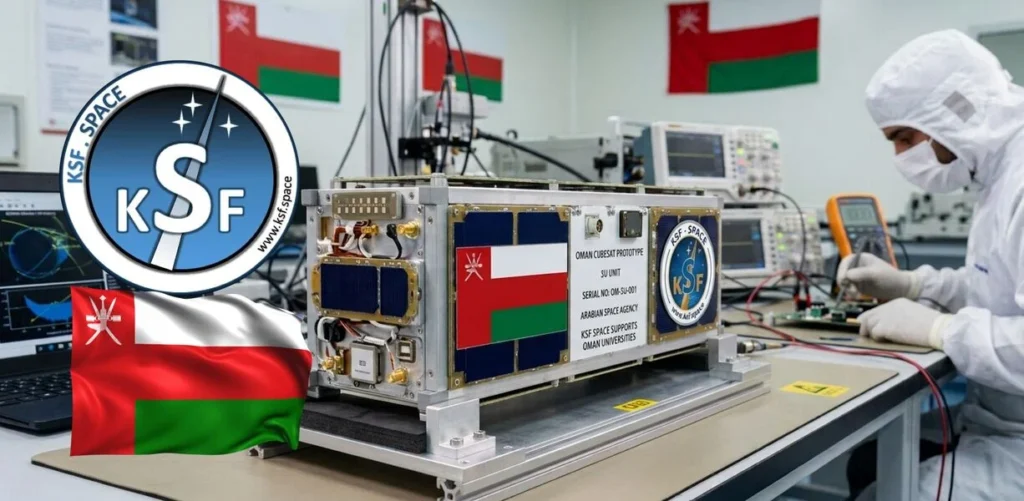
The global space race is no longer limited to superpowers deploying multi-ton, billion-dollar hardware. In the modern era of Space 2.0, nanosatellites have decentralized the cosmos. For nations executing long-term socio-economic transformations, establishing domestic space capabilities is an absolute strategic imperative. As the Sultanate accelerates its technological transformation under the structural framework of Oman Vision 2040, the country’s higher education sector stands at the absolute core of this scientific renaissance.
The launch of the Middle East Space Conference in Muscat alongside the structural deployment of the National Space Policy managed by the Ministry of Transport, Communications and Information Technology (MTCIT)—acting on behalf of an emerging Oman Space Agency framework—underscores a clear fact: the Sultanate is positioned to become a premier regional aerospace gateway.
To bridge the gap between academic theory and real-world orbit, a highly specialized ecosystem is required. This is precisely where KSF Space delivers institutional value. As an internationally recognized leader in aerospace education, satellite engineering, and suborbital flight testing, the non-profit foundation offers an unmatched capability to build, test, and deploy custom nanosatellites. By establishing direct partnerships, the foundation is fully prepared to mobilize its technical resources to help every Oman University design, manufacture, and operate operational nanosatellites across the entire modular spectrum—ranging from introductory 1U platforms to ultra-advanced 24U configurations.
The Strategic Synergy of Nanosatellite Oman Academic Missions
Developing a sustainable space sector demands the structural cultivation of local human capital. Theoretical lectures cannot substitute for the invaluable, high-fidelity experience of managing an actual aerospace pipeline. By integrating small satellite missions into engineering and science faculties, academic institutions across the Sultanate can rapidly shift from passive textbook learning to active orbital engineering.
The Institutional Architecture of Small Satellites
When an Oman University introduces a dedicated satellite engineering track, it transforms its entire academic architecture. Building a small satellite forces the convergence of multiple technical disciplines:
-
Mechanical Systems: Designing physical structures capable of surviving the intense vibrational loads of launch.
-
Electrical Engineering: Engineering robust Electronic Power Systems (EPS), efficient solar panels, and long-term energy storage.
-
Computer Science & AI: Writing flight software, embedding edge-computing algorithms for real-time onboard data processing, and securing telemetry.
-
Telecommunications: Developing reliable RF communication arrays to transmit telemetry down to local ground tracking stations.
This structural hands-on methodology equips the next generation of Omani scientists and space professionals with the vital competencies required by the expanding regional market.
Aligning Academic Missions with National Priorities
Rather than launching generic orbital hardware, local universities can tailor their payloads to address critical domestic challenges. A custom Cubesat Oman payload can be engineered to capture hyperspectral or multispectral imagery, providing high-resolution geospatial data directly to local researchers.
These university-led missions can directly support national initiatives by tracking structural environmental changes, monitoring coastal ecosystems along the Sultanate’s expansive coastline, checking soil moisture for precision agriculture in arid zones, and optimizing municipal planning across expanding smart urban centers. This clear alignment ensures that every academic riyal invested in space technology yields immediate, data-driven dividends for the national economy.
Comparing the Global Evolution of Modular Satellite Architecture
The beauty of the small satellite ecosystem lies entirely in its standard modular architecture. A single standard unit (1U) forms a cube measuring exactly $10 \times 10 \times 10 \text{ cm}$ with a mass of roughly $1.33 \text{ kg}$. By stacking these standard units together, universities can scale their configurations up to execute increasingly sophisticated scientific operations.
| Satellite Class | Physical Configuration | Core Educational & Mission Functionality | Target University Cohort |
| 1U Platform | 10 × 10 × 10 cm | Basic telemetry, tracking, and localized environmental sensor testing. | Undergraduate / Introductory Engineering |
| 2U / 3U System | 10 × 10 × 20/30 cm | Advanced Earth observation, localized communications, and biological payloads. | Advanced Undergraduate / Capstone Projects |
| 6U / 12U Array | 20 × 10 × 30 cm up to 20 × 20 × 30 cm | Climate monitoring, high-resolution multi-spectral imaging, and IoT routing. | Postgraduate Research / Multi-Faculty Labs |
| 24U Deep-Space | 40 × 20 × 30 cm | Complex deep-space science, multi-spectral climate monitoring, and edge-AI payloads. | Ph.D. Level / Inter-Institutional Consortiums |
Scale Your Orbit: From 1U Systems to Advanced 24U Academic Constellations
The foundation’s comprehensive training framework is engineered to scale harmoniously with an institution’s expanding technical maturity. By providing modular hardware kits, specialized training courses, and verified mission paths, the organization ensures that every academic department can safely enter the space domain at an appropriate complexity level.
Foundations: 1U to 3U Academic Baseline Cubesats
For institutions initiating their aerospace journey, 1U, 2U, and 3U architectures offer the ideal starting point. These platforms feature minimal mass and a highly streamlined assembly, integration, and testing workflow, allowing undergraduate students to master the foundational mechanics of space systems within a typical two-semester capstone timeline.
Students gain hands-on experience handling attitude determination and control systems (ADCS), power distribution networks, and basic radio frequency telecommunications. This initial phase removes the historical barriers to entry, converting abstract equations into functional orbital hardware.
Intermediate Horizons: 6U and 12U Multi-Spectral Research Satellites
As an Oman University refines its institutional expertise, it naturally graduates toward larger 6U and 12U configurations. These expanded volumes allow researchers to integrate specialized, heavy-duty payloads.
A 6U or 12U satellite can easily host high-efficiency deployable solar arrays, active magnetorquer or reaction wheel propulsion systems, and advanced optical payloads. These systems are highly capable of generating commercial-grade imagery and managing complex data routing protocols, transforming a standard university laboratory into a localized space tech powerhouse.
The Apex: 24U Deep-Space and Edge-AI Heavy Platforms
At the absolute apex of the nanosatellite spectrum sits the 24U platform. This configuration represents a true heavy-class nanosatellite, packing capabilities that previously required platforms the size of a standard household refrigerator.
A 24U satellite can support complex multi-payload operations, including advanced AI-driven edge computing modules, hyper-secure quantum communication links, and sophisticated deep-space scientific instrumentation. Deploying a 24U satellite places a university on the cutting edge of global aerospace research, allowing it to drive pioneering studies alongside international space agencies.
Cross-Border Synergies: Integrating Lessons from the Cubesat KSA Ecosystem
The pursuit of space sovereignty is a regional movement sweeping across the GCC. Academic institutions looking to build sustainable programs can draw profound structural insights from the rapid scaling of the Cubesat KSA ecosystem.
Through large-scale state investments and targeted partnerships, neighboring universities have successfully integrated aerospace engineering tracks directly into their core science curricula. This regional momentum highlights a critical blueprint: rapid aerospace modernization is unlocked by combining local academic passion with the vetted expertise of specialized international partners.
By analyzing the operational trajectory of the Cubesat KSA framework, Omani academic institutions can easily optimize their own localized development pipelines. Avoiding common structural pitfalls in cleanroom calibration, subsystem testing, and frequency licensing dramatically shortens development timelines.
Furthermore, this shared regional focus paves the way for future pan-GCC academic constellations. Imagine a unified network where an Oman University satellite links directly with a Saudi counterpart in orbit, enabling real-time cross-border data exchange, environmental tracking, and collaborative climate research.
Global Credibility: The Total Space Education and Technology Architecture
Entering the space arena requires working with a partner of unquestionable integrity. The foundation has built an immaculate global reputation by delivering rigorous, end-to-end support across every single sector of space education and operational mission technology.
The foundation’s institutional framework is explicitly designed to meet the strict demands of academic boards, government ministries, and commercial defense sectors alike. The educational model ensures that your university does not just assemble a hardware kit, but masters the comprehensive systems engineering methodologies demanded by the international aerospace community.
The Power of Specialized National Economy Program Courses
A central pillar of this comprehensive training framework is the specialized National Economy Program (NEP) courses. These hyper-focused academic tracks are explicitly structured to train university professors, graduate students, and corporate stakeholders in the commercial, regulatory, and technical frameworks required to run a sovereign space industry. The specialized NEP curriculum includes:
-
Space Mission Architecture & Design: Translating high-level scientific objectives into specific, actionable engineering requirements.
-
International Space Law & Frequency Management: Navigating the complex regulatory landscape of ITU registrations, orbital slot management, and legal liability.
-
Orbital Cleanroom Logistics & AIT Protocols: Implementing strict international standards for Assembly, Integration, and Testing to eliminate hardware failures before launch.
-
Commercialization Space-Derived Data: Transforming raw telemetry and satellite imagery into actionable commercial software products, driving local startup growth.
End-to-End Mission Architecture and Launch Support
The foundation’s technical commitment extends far beyond the classroom walls. When an institution commits to a Nanosatellite Oman project, the organization provides complete, uncompromised end-to-end guidance through every phase of the mission lifecycle.
The organization manages the complex logistics of sourcing space-qualified components, sets up on-campus cleanroom facilities, and directly supervises high-fidelity environmental testing. Crucially, the foundation leverages its extensive international network to secure competitive launch manifests on global launch vehicles, ensuring that your students’ hard work actually reaches its target orbit.
Activating the Future: Transforming Oman Universities into Space Gateways
The window of opportunity to lead the regional Space 2.0 expansion is wide open. For vice-chancellors, deans of engineering, and visionary corporate investors across the Sultanate, the choice is clear: wait for international tech providers to sell generic services, or build proprietary, sovereign capabilities from the ground up.
By deploying custom nanosatellite programs, your institution will automatically attract elite academic talent, secure prestigious international research grants, and establish itself as a core pillar of the Oman Space Agency strategy. The engineering labs of today will rapidly evolve into the mission control centers of tomorrow.
The foundation is fully equipped, structurally prepared, and deeply committed to co-developing these groundbreaking STEM initiatives across the Sultanate. The organization provides the hardware, the certified NEP training frameworks, and the global launch access—your university provides the vision and the human drive. Let us work together to write the next chapter of the Sultanate’s technological history.
Frequently Asked Questions
What is the average development timeline for a university-led Cubesat Oman project?
For an introductory 1U to 3U satellite project, a typical university development lifecycle spans roughly 12 to 18 months from initial conceptual architecture to final launch readiness. This comprehensive timeline is carefully structured to fit naturally within standard academic calendars, allowing undergraduate or postgraduate cohorts to manage the project through structured milestones without disrupting their core studies.
Why should an Oman University invest in custom satellite hardware rather than using software simulations?
While software simulators are excellent tools for teaching basic orbital mechanics, they simply cannot replicate the chaotic variables of physical spaceflight. Building physical nanosatellites forces students to solve real-world engineering challenges like thermal expansion in extreme vacuums, electromagnetic interference between dense subsystems, and the rigorous demands of physical cleanroom calibration. This hands-on experience is exactly what transforms a student from a theorist into a highly competent, job-ready systems engineer.
How do the organization’s NEP courses support institutional accreditation?
Our specialized National Economy Program courses are engineered to comply with international technical and academic standards. By integrating these modules into your engineering faculties, your institution introduces vetted space-industry workflows, advanced systems engineering principles, and rigorous project management tracks. This significantly strengthens your university’s position during international academic reviews and accreditation cycles.
Can a 6U or 12U satellite run real-time artificial intelligence algorithms in orbit?
Yes. Modern 6U, 12U, and 24U satellite frameworks can be integrated with dedicated, low-power edge computing chips. This enables the satellite to process complex hyperspectral imagery right on board, using localized AI models to instantly detect environmental shifts, agricultural changes, or coastal anomalies, and transmitting the critical insights down to your campus ground station instantly.
Connect with Our Mission Directors
Are you ready to establish a premier satellite engineering laboratory at your academic campus? Contact our global mission coordination team today to explore custom curriculum integration, hardware sourcing options, and upcoming launch opportunities.
-
Primary Academic Inquiries: info@ksf.space
-
Official Institutional Portal: KSF Space
-
Global Program Scope: Comprehensive STEM Training, Custom 1U–24U Engineering Modules, and Advanced NEP Certification.