
CEO at 4DBC Group
3U CubeSat Structure
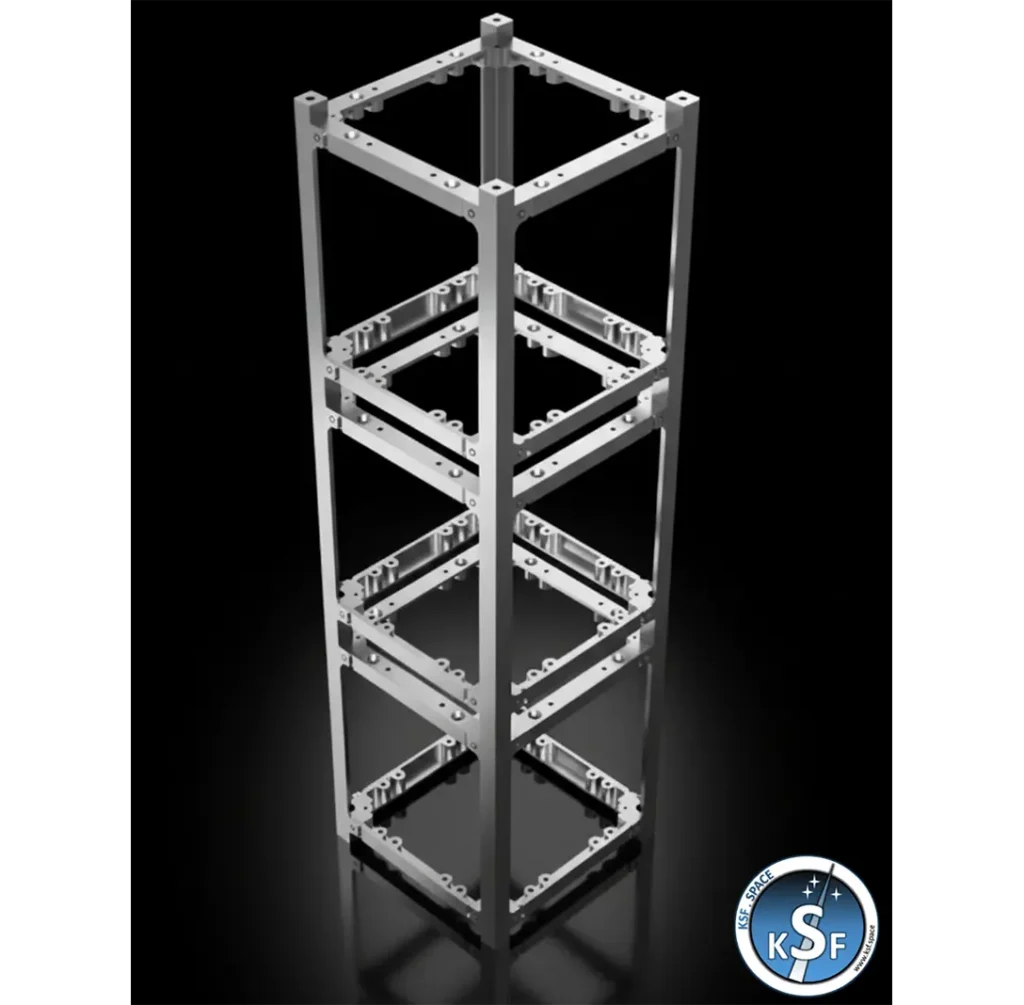
In the rapidly evolving NewSpace economy of 2026, the 3U CubeSat structure has emerged as the industry standard for commercial imaging, IoT constellations, and advanced scientific research. Choosing the right chassis is no longer just about dimensions; it is about thermal management, mass efficiency, and orbital reliability.
At KSF Space (available at www.ksf.space), we have redefined the barrier to entry for orbital missions. By offering a dual-track approach—precision-machined Aerospace-Grade Aluminum and innovative Education PA11—we provide the highest quality satellite frames at the industry’s most competitive pricing.
Why the 3U CubeSat Structure is the Gold Standard for Modern Missions
The “U” in CubeSat stands for one unit of 10x10x10 cm. While a 1U or 2U CubeSat structure aluminum frame serves smaller technology demonstrators, the 3U CubeSat structure (10x10x30 cm) provides the critical volume required for high-gain antennas, deployable solar arrays, and complex propulsion systems.
Precision Engineering and Material Science
A satellite’s structure must act as more than a simple box. It is a Faraday cage, a thermal radiator, and a protective shield against the violent vibrations of a rocket launch. KSF Space utilizes a combination of CNC-machined aluminum and industrial additive manufacturing to meet these rigorous demands.
Aluminum 6061-T6/7075: Used for professional flight models, these alloys offer a superior stiffness-to-weight ratio and excellent thermal conductivity.
Education PA11 (Polyamide 11): This bio-sourced polymer is a game-changer for university projects. It is 40% lighter than aluminum and significantly more affordable, without sacrificing the structural integrity needed for orbital testing.
Technical Features: 2U and 3U CubeSat Structures by KSF Space
Whether you are scaling a 2U design or deploying a full 3U configuration, our structures are built to the NASA-GSFC-STD-7000 (GEVS) framework. This ensures that your satellite isn’t just a prototype—it is a flight-ready asset.
The Aluminum Advantage: Thermal Conductivity and Shielding
For high-power missions, aluminum remains the “gold standard.” The metallic frame acts as a heat sink, pulling thermal energy away from high-duty-cycle transmitters and dissipating it through the outer rails. Furthermore, the KSF Space hard-anodized finish prevents “cold welding”—a phenomenon where raw metal surfaces fuse together in the vacuum of space, preventing deployment from the P-POD.
The PA11 Revolution: Lightweight Education and Prototyping
For educational institutions, the KSF Space PA11 series offers an unrivaled path to orbit. Utilizing Multi Jet Fusion (MJF) technology, our PA11 structures are isotropic and durable. They are verified for vacuum stability with a Total Mass Loss (TML) of less than 1.0%, ensuring your optical payloads remain free from contamination.
Optimized for Orbital Success: Tested and Proven
Quality at KSF Space is verified through advanced SOLIDWORKS Flow Simulation and Finite Element Analysis (FEA). Every 3U CubeSat structure is designed to withstand a 1.4 Factor of Safety for ultimate loads, ensuring the chassis remains intact through Max-Q (maximum dynamic pressure).
“By providing a CubeSat structure that is both affordable and technically rigorous, we are enabling the next generation of researchers to move from conceptual design to orbital reality faster.” — Dr. Mohamed ElKayyali, Chairman of KSF Space.
Frequently Asked Questions (FAQ)
1. Why choose a 3U CubeSat structure over a 2U model?
While a 2U CubeSat structure aluminum frame is excellent for smaller payloads, the 3U format is the preferred “workhorse” for commercial missions. It provides the necessary surface area for body-mounted or deployable solar panels, which are essential for powering high-bandwidth communication systems.
2. Is PA11 really safe for orbital missions?
Yes. When processed using industrial MJF and vapor-honing (Black Smooth finish), PA11 meets NASA’s strict low-outgassing requirements. It is a “living” polymer with high ductility, making it exceptionally resilient to mechanical shocks during separation.
3. How does KSF Space maintain such competitive pricing?
By leveraging advanced manufacturing techniques like additive manufacturing for educational models and streamlined CNC processes for aluminum, we reduce labor costs and lead times. We believe in democratizing space access, which means making high-quality hardware accessible to all.
4. Are the structures compatible with standard PC/104 boards?
Absolutely. All KSF Space structures, from 1U to 3U, are fully compliant with the Cal Poly CubeSat Design Specification (CDS) and the PC/104 mounting standard.
5. What is the difference between “Grey Raw” and “Black Smooth” finishes?
“Grey Raw” is a matte finish ideal for rapid prototyping and ground-based testing. “Black Smooth” is our premium vapor-honed finish that seals the surface of the PA11, minimizing outgassing and maximizing thermal emissivity for flight.
Conclusion: Start Your Journey to Orbit with KSF Space
The foundation of your mission is its structure. Whether you require the thermal resilience of a 3U CubeSat structure in aluminum or the mass-saving benefits of our PA11 education series, KSF Space delivers the balance of pricing and quality required for modern space exploration.
Ready to launch? Explore our full catalog and request a technical quote at www.ksf.space.
- Engineering Support: info@ksf.space