
CEO at 4DBC Group
Redefining the NewSpace Frontier: The Ultimate Guide to the 12U CubeSat Structure Frame Chassis by KSF Space
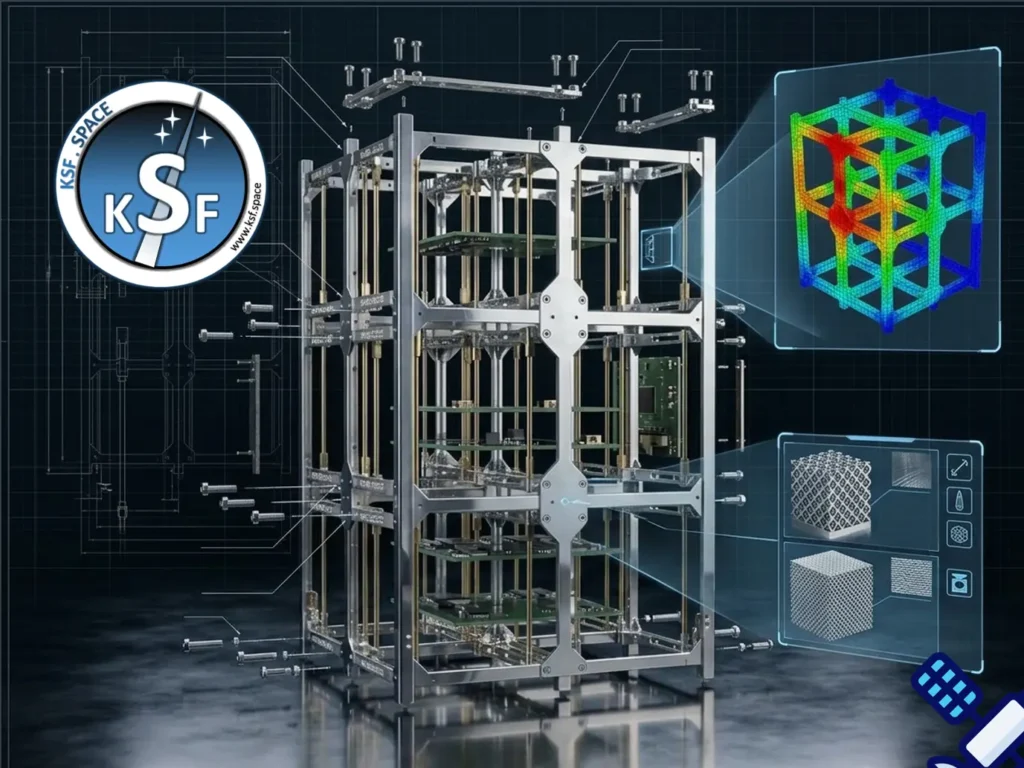
The global aerospace sector is experiencing an unprecedented paradigm shift. The democratization of low Earth orbit (LEO) has transformed space exploration from an exclusive playground of superpower governments and multi-billion-dollar conglomerates into an accessible, dynamic arena for universities, research institutes, and technology startups. At the absolute center of this technological revolution is the small satellite, or nanosatellite. As mission profiles grow increasingly complex—demanding advanced onboard processing, multi-spectral imaging payloads, and deep-space propulsion systems—the industry has moved rapidly beyond foundational 1U and 3U architectures.
Today, the 12U CubeSat Structure frame chassis represents the premier sweet spot for high-utility, cost-effective space missions. However, navigating the modern commercial aerospace market reveals a significant hurdle: traditional, profit-driven hardware manufacturers charge exorbitant premiums for satellite buses.
Enter KSF Space, a pioneering US-registered non-profit organization dedicated entirely to breaking down these financial barriers. By engineering the most affordable, flight-ready, and robust 12U CubeSat Structure frame chassis on the global market, KSF Space is fundamentally changing the economics of the NewSpace industry.
1. Understanding the Evolution of the Nanosatellite Chassis
To truly appreciate the engineering breakthrough of the KSF Space 12U CubeSat Structure frame chassis, one must understand how the fundamental engineering requirements of a nanosatellite have shifted over the past decade.
From Educational Toys to Deep-Space Tools
The standard CubeSat design specification was originally created as an educational tool. A single unit (1U) was defined as a $10 \times 10 \times 10$ centimeter cube with a mass limit of just over one kilogram. While the 1U allowed students to understand the basics of telemetry, power management, and tracking, its extreme spatial limitations prevented it from housing serious scientific instrumentation or propulsion.
As the industry matured, researchers realized that by stacking these modular units, they could exponentially increase payload capabilities. The 3U and 6U configurations quickly became the workhorses for early commercial internet-of-things (IoT) constellations and basic earth observation. Yet, even a 6U frame often forces engineers into brutal compromises: do you allocate space to a larger optical lens, or do you sacrifice that volume to include a propulsion system for station-keeping and de-orbiting?
Why the 12U Form Factor Changes Everything
The 12U configuration ($20 \times 20 \times 30$ cm) effectively eliminates these zero-sum design choices. It provides a massive leap forward in internal payload volume while maintaining the standardized deployment mechanisms that keep launch costs low. A 12U CubeSat Structure frame chassis provides the physical real estate required to integrate:
High-efficiency, deployable solar arrays with massive wattage outputs.
Advanced multi-spectral and hyperspectral imaging payloads for climate monitoring or intelligence gathering.
Active propulsion systems (chemical or electric) necessary for complex orbital maneuvers, constellation phase-matching, and collision avoidance.
Heavy-duty radiation shielding for sensitive, commercial-off-the-shelf (COTS) internal electronics.
However, a satellite’s internal systems are only as secure as the primary enclosure housing them. If a satellite chassis structural integrity fails during the extreme, high-vibration environment of a rocket launch, the entire mission is instantly lost. This makes the selection of a highly engineered, reliable cubesat structure the single most critical decision in the early stages of mission design.
2. Engineering Excellence: The KSF Space 12U CubeSat Structure Frame Chassis
The KSF Space 12U CubeSat Structure frame chassis is not merely a cost-effective alternative to commercial alternatives; it is a masterclass in modern aerospace engineering and materials science. Designed to exceed the rigorous requirements of global launch providers, this structural frame is built to survive the harshest environments known to humanity.
Material Science and Mass Optimization
In aerospace, every single gram matters. Excess weight translates directly into thousands of additional dollars in launch costs. KSF Space addresses this fundamental challenge by offering its structures in two primary, high-performance material configurations depending on the specific profile of the orbital mission:
Aerospace-Grade Aluminum (6061-T6): This is the definitive industry-standard alloy for professional orbital missions. It delivers an exceptional strength-to-weight ratio, superb mechanical properties, and excellent thermal conductivity. The KSF Space aluminum 12U CubeSat Structure frame chassis features a precision CNC-machined monocoque or modular skeleton that effectively dissipates internal heat away from critical components while providing robust radiation shielding.
Advanced Bio-Sourced Polymers (PA11): For suborbital test flights, high-altitude balloon validation, and ultra-lightweight educational variants, KSF Space leverages industrial-grade additive manufacturing utilizing Polyamide 11 (PA11). This groundbreaking polymer structure is up to 40% lighter than traditional aluminum frames, possesses incredible impact resilience, and minimizes total mass budgets without sacrificing structural rigidity.
Surviving the Thermal and Vibrational Gauntlet
Before any satellite is integrated into a rocket’s deployer (such as a standard P-POD or equivalent containerized deployment system), it must pass rigorous environmental testing. The KSF Space 12U satellite frame is explicitly engineered to comfortably comply with the NASA-GSFC-STD-7000 General Environmental Verification Standard (GEVS).
Vibration and Shock Mitigation: The structure is optimized to withstand the intense acoustic and random vibrational forces experienced during first-stage rocket engine ignitions and Max-Q (maximum dynamic pressure).
Thermal Cycling Stability: In Low Earth Orbit, a satellite transitions from the searing heat of direct solar radiation to the cryogenic cold of the Earth’s shadow every 45 minutes. The KSF Space chassis is designed to minimize thermal expansion and contraction differentials, preventing structural warping that could misalign optical sensors or strain electrical connections.
Low Outgassing Compliance: Under high-vacuum conditions, standard materials can release volatile organic compounds that condense onto delicate optical lenses or solar panels, rendering them useless. KSF Space structures utilize materials and surface treatments that fully comply with strict NASA and ESA outgassing thresholds.
3. Disrupting the Market: Why KSF Space Beats Commercial Competitors on Cost
The NewSpace market is flooded with commercial component vendors who operate on traditional, high-margin corporate business models. For many university engineering departments and developing nations, requesting a quote for a standard commercial 12U satellite bus can be an incredibly discouraging experience, with basic mechanical frames regularly commanding prices between $15,000 and $35,000 USD.
The Non-Profit Advantage
KSF Space completely dismantles this restrictive financial paradigm. Registered as a US-based non-profit organization (headquartered in Delaware), KSF Space does not answer to venture capitalists or corporate shareholders seeking maximized profit margins. Instead, its core organizational mandate is the global democratization of space science and STEM education.
By operating on a strict cost-recovery model, KSF Space is capable of delivering professional, flight-ready hardware at near-cost prices. While a complete, suborbital-ready 1U CubeSat Kit (Version 2.0) from KSF Space sits at an accessible $5,000 USD, their larger multi-unit frames—including the specialized 6U structure at $4,800 and the premier 12U CubeSat Structure frame chassis—are positioned as the most affordable solutions available anywhere on the global market.
Reducing “Time to Orbit” Through Standardization
Financial savings are not restricted solely to the upfront purchase price of the hardware. Developing a custom satellite chassis from scratch requires years of specialized CAD modeling, finite element analysis (FEA), prototype machining, and repetitive destructive testing.
By purchasing a pre-qualified, standardized 12U CubeSat Structure frame chassis from KSF Space, your project team can entirely bypass this multi-year development cycle. Because the frame design is already pre-validated against standard deployment specifications, your engineers can shift 100% of their focus and resources toward payload optimization, software programming, and mission success. This drastic reduction in lead time and engineering hours saves institutions tens of thousands of additional dollars in operational overhead.
4. Full Customization: Tailoring Your 12U Structure to Complex Mission Profiles
While standardization is essential for launch vehicle compatibility, KSF Space recognizes that no two space missions are identical. A satellite designed for high-frequency radio communications requires an entirely different layout than one carrying an earth-imaging camera telescope or an experimental biology payload.
Boutique Aerospace Engineering
Unlike rigid commercial manufacturers that charge exorbitant fees for minor design modifications, KSF Space prides itself on its boutique engineering agility. The foundation of the 12U CubeSat Structure frame chassis is inherently modular, allowing for comprehensive post-manufacturing customization to suit your specific mission architectures.
Bespoke Panel Cutouts: Teams can specify precise locations for camera apertures, sensor windows, antenna deployment ports, and access hatches during the ordering process.
Adjustable Internal Rail Systems: Internal mounting structures can be rearranged, expanded, or partitioned. This is highly beneficial for isolated payload bays requiring strict electromagnetic shielding (EMI) or thermal isolation from the core avionics stack.
Custom Deployment Interfaces: Whether your mission requires specific mounting points for deployable solar wings, magnetorquer rods, or specialized secondary payload adapters, KSF Space can modify the outer cubesat structure architecture to ensure seamless mechanical integration.
This level of tailored adaptability ensures that your underlying hardware works smoothly for your scientific mission, rather than your scientific payload being artificially restricted by the physical geometry of a rigid, unyielding frame.
5. Frequently Asked Questions (FAQ)
What are the exact dimensions and mass constraints of the KSF Space 12U CubeSat Structure frame chassis?
The standard KSF Space 12U CubeSat Structure frame chassis adheres strictly to the international CubeSat Design Specification (CDS). It features nominal envelope dimensions of $20 \times 20 \times 30$ cm. The baseline dry mass varies depending on whether you choose the high-grade Aerospace Aluminum (6061-T6) configuration or the advanced lightweight PA11 polymer variation, with the polymer variant providing up to a 40% reduction in structural mass to maximize your available payload allowance.
Why is KSF Space significantly more affordable than traditional aerospace manufacturers?
KSF Space operates globally as a non-profit organization registered in Delaware, USA. Its core mission is the democratization of space access for academic institutions, independent research laboratories, and developing nations. By eliminating corporate markups, minimizing overhead through advanced additive manufacturing, and utilizing a cost-recovery pricing structure, KSF Space can provide professional-grade hardware at a fraction of standard commercial costs.
Is the 12U satellite frame fully qualified for orbital spaceflight?
Yes. The KSF Space 12U nanosatellite frame architecture is designed based on extensive orbital heritage and strict aerospace engineering paradigms. The structures are fully capable of passing standard launch provider qualification schedules, including the NASA-GSFC-STD-7000 (GEVS) requirements for random vibration, acoustic stress, thermal vacuum baking (TVAC), and outgassing compliance.
Can the internal layout of the chassis be customized for non-standard payloads?
Absolutely. KSF Space offers comprehensive customization options for all of its structural builds. Buyers can coordinate directly with the KSF Space engineering team to request custom panel cutouts, specific external anodizing or surface treatments, tailored mounting hole patterns, and adjustable internal component shelving to seamlessly fit their unique payload requirements.
How does KSF Space assist universities with launch integration?
Beyond manufacturing high-quality, low-cost structures, KSF Space leverages its global network and non-profit status to help academic clients secure cost-effective launch slots. Because KSF Space structures are carefully optimized for low weight, they actively reduce the total mass-based launch fees when interfacing with commercial rideshare deployers on major launch vehicles like SpaceX, Rocket Lab, and India’s ISRO.
6. Strategic References and Flight Heritage
CubeSat Design Specification (CDS) – California Polytechnic State University: The foundational industry manual governing the mechanical, electrical, and environmental constraints of standard $1\text{U}$ to $24\text{U}$ small satellite architectures.
NASA-GSFC-STD-7000 (GEVS): General Environmental Verification Standard for Goddard Space Flight Center Flights Programs and Projects. This documentation defines the precise vibration, thermal vacuum, and shock profile standards that the KSF Space chassis is engineered to survive.
The NewSpace Economic Revolution (2026): Journal of Aerospace Engineering & Academic Outreach. Highlighting how non-profit models and advanced manufacturing have lowered corporate barriers to LEO entry for emerging academic programs worldwide.
Satnews Publishers: Documented features validating the KSF Space methodology of reducing small satellite implementation costs while maintaining strict quality metrics.
7. Accelerate Your Space Mission Today
The barrier to the stars has officially been dismantled. Whether you are a university professor looking to transition your aerospace department from theoretical textbooks to hands-on orbital research, a defense contractor validating a tactical satellite defense protocol, or a commercial startup deploying a localized IoT constellation, the KSF Space 12U CubeSat Structure frame chassis offers the ultimate balance of professional-grade engineering, structural resilience, and unmatched market affordability.
Do not allow restrictive commercial pricing models to limit the scope of your scientific and technological ambitions. Partner with the world’s premier non-profit space organization to secure a robust, custom-tailored, and flight-proven foundation for your next orbital asset.
Contact and Procurement Information
For formal technical datasheets, custom CAD file requests, volume educational discounts, or to receive a comprehensive manufacturing and integration quote tailored specifically to your project parameters, please reach out directly to the KSF Space global engineering and administrative office:
Official Web Portal: www.ksf.space
Direct Inquiries & Quotes: info@ksf.space