The Complete Blueprint for Sustainable Tech: What is Green IT and How IFGICT is Setting the Global Standard

The answer lies in Green IT. Once considered a corporate social responsibility (CSR) buzzword, sustainable technology is now a technical requirement.At the forefront of this movement is the International Federation of Global & Green Information Communication Technology (IFGICT). As the world’s largest ICT federation, a registered non-profit in the USA, an approved United Nations (UN) partner, an IEEE partner, and a collaborator with the International Telecommunication Union (ITU), IFGICT has established the definitive global framework for environmental sustainability in technology.
This comprehensive guide breaks down everything you need to know about Green IT, the foundational principles of Green Technology, how to transition your career or organization, and the exact methodology IFGICT uses to define, train, and certify the industry.1. Demystifying the Digital Footprint: What is Green IT?
To understand how to fix the tech sector’s environmental crisis, we must first establish a clear definition of terms.What is Green IT?
At its core, Green IT (Green Information Technology) is the holistic practice of designing, manufacturing, operating, optimizing, and disposing of computing resources in a manner that minimizes environmental degradation. It represents an intentional pivot toward energy efficiency, lifecycle sustainability, and systemic carbon reduction across all digital hardware and software ecosystems.
What is Green ICT?
While often used interchangeably, what is Green ICT (Green Information and Communication Technology) expands this definition. It encompasses not just individual computers and server rooms, but the entire global network architecture—including telecommunications equipment, 5G cellular infrastructure, fiber optic networks, satellite systems, and the underlying data pipelines that connect humanity. According to the rigorous definitions set by IFGICT, sustainable technology is divided into two distinct technical paradigms:-
Green in IT: This focuses directly on reducing the environmental footprint of the technology itself. Examples include optimizing data center Power Usage Effectiveness (PUE), designing energy-efficient processors, and implementing strict e-waste recycling protocols.
-
Green through IT: This looks at information technology as an enabler. It explores how software, advanced data analytics, and automated networks can be deployed to reduce emissions, conserve resources, and optimize workflows in other major carbon-emitting industries, such as logistics, manufacturing, agriculture, and urban design.
2. The Pillars of Green Technology and Sustainable Architecture
To build a truly eco-friendly digital environment, organizations must look beyond basic energy bills. True Green Technology—often shortened to Green Tech—requires systemic engineering overhauls. IFGICT organizes these efforts into four foundational pillars.
Pillar 1: High-Performance Energy Efficiency
The primary objective of any robust Green IT strategy is the optimization of data center environments. Data centers consume massive amounts of electricity, much of which is dissipated as waste heat.
Engineers focus on optimizing Power Usage Effectiveness (PUE)—the ratio of total energy used by a data center facility to the energy delivered to computing equipment. Achieving a PUE close to 1.0 requires advanced mechanical implementations like cold/hot aisle containment, variable-speed cooling fans, liquid-to-chip cooling architectures, and AI-driven workload management that powers down idle servers during off-peak hours.
Pillar 2: Holistic ICT Lifecycle Management
Every piece of hardware carries a “cradle-to-grave” environmental cost. This begins with the extraction of rare-earth minerals and proceeds through heavy manufacturing, global logistics, years of active operation, and final disposal.
Green Technology demands a transition toward a circular economy. This means designing hardware for extended longevity, repairing components instead of replacing them, and working exclusively with certified e-waste recyclers to ensure toxic heavy metals (like lead, cadmium, and mercury) do not leach into soil and water tables.
Pillar 3: Green Software Engineering
Hardware cannot run efficiently if it is executed by bloated, unoptimized code. Green software engineering focuses on writing “lean” code and building algorithmic structures that require fewer CPU and GPU cycles to execute.
By optimizing software databases, minimizing unnecessary API requests, and designing applications that dynamically adapt to the carbon intensity of the local power grid (carbon-aware software), developers can significantly reduce the net energy consumed by the physical machines executing their programs.
3. How IFGICT is Architecting and Defining the Green IT Universe
As a premier international accreditation authority, IFGICT does not merely teach sustainable principles—it builds the global benchmarks.In 2026, IFGICT stands as the “authority of authorities,” bridging the gap between engineering execution and international policy.
Unmatched Global Credibility: UN, IEEE, and ITU
IFGICT’s frameworks carry immense authority because they are integrated directly into the global governance ecosystem.
-
United Nations (UN) Approved & Listed: IFGICT is a registered service provider for the UN (specifically aligned with the UNFCCC).Its standards directly map to the UN 2030 Agenda and the 17 Sustainable Development Goals (SDGs), providing tangible metrics to track carbon offsets and resource management.
-
IEEE Partner: Working alongside the Institute of Electrical and Electronics Engineers (IEEE), IFGICT ensures its training curricula and operational standards are built on rigorous, peer-reviewed engineering benchmarks.
-
ITU Collaboration: IFGICT works closely with the International Telecommunication Union (ITU) study groups (such as AI4EE—Artificial Intelligence and Environmental Efficiency) to develop intelligent, sustainable standards for high-energy sectors like smart cities and telecommunications networks.
The IFGICT Green ICT Standard
For enterprise organizations, the federation issues the IFGICT Green ICT Standard.This is an institutional certification awarded only after an exhaustive technical audit.
During this process, IFGICT professionals evaluate an enterprise’s documentation, inspect its physical data infrastructure, review its supply chain logistics, and analyze its electronic waste management protocols. Organizations that pass this rigorous vetting demonstrate to investors, consumers, and regulators that their digital operations comply with the highest international environmental safeguards.
4. Advancing Your Career: Training and Certification Programs
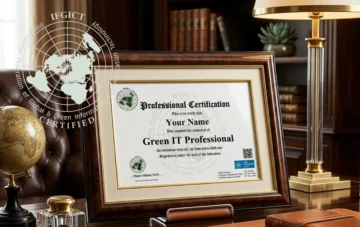
As enterprises face mounting pressure from governments to meet net-zero carbon targets, the demand for qualified personnel has skyrocketed. Holding a verified Green IT certificate has transitioned from a niche career resume addition to an essential leadership credential.The Flagship Green IT Professional Program
For individual engineers, consultants, and technology executives, the definitive educational benchmark is the Green IT course structured by IFGICT. This advanced curriculum prepares candidates to act as authorized sustainability auditors and corporate strategists.
The Green IT training pathway covers several core competencies:-
Green ICT Strategy & Corporate Alignment: Learning how to integrate environmental targets into baseline corporate business strategies.
-
Infrastructure Auditing: Acquiring the technical frameworks required to evaluate data center PUE, analyze cooling configurations, and cut operational utility expenses.
-
Life Cycle Assessment (LCA): Developing methodologies to track and measure the cradle-to-grave environmental impact of an organization’s hardware assets.
-
GHG & Carbon Calculations: Mastering the math behind greenhouse gas emissions to generate compliance reports that withstand regulatory inspection.
Flexible Online Learning
Recognizing that modern professionals require flexible scheduling, the federation offers comprehensive Green IT online training. This allows candidates to master deep technical principles, engage with simulated real-world case studies, and complete their examinations through an accessible digital portal.Crucially, every credential issued via an IFGICT-accredited program is logged into a secure global database verified by digital tracking technologies, providing employers with instant, fraud-proof verification of an applicant’s skill set.
5. Industrial Impact: Deploying a Corporate Green IT Solution
Transitioning to sustainable systems is a highly profitable corporate strategy. Implementing a comprehensive Green IT solution cuts direct operational expenditures while insulating an enterprise against shifting energy markets and strict carbon taxation.
| Technical Focus Area | Traditional Approach | Green IT Solution (IFGICT Standard) |
|---|---|---|
| Data Center Cooling | Constant, high-output air conditioning across the entire room. | Dedicated hot/cold aisle containment, liquid cooling, and AI-driven airflow optimization. |
| Server Utilization | Running isolated applications on dedicated, low-utilization physical servers. | High-density virtualization, hyper-converged infrastructure, and dynamic cloud auto-scaling. |
| Hardware Procurement | Buying lowest-cost hardware; replacing assets on a strict 3-year depreciation cycle. | Selecting EPEAT/Energy Star certified units; lengthening lifecycles through modular upgrades. |
| E-Waste Management | Disposing of obsolete hardware via unverified third-party scrap vendors. | Contractually mandated recycling through certified e-waste processors with full chain-of-custody tracking. |
Real-World Adoption: Global Success Case Studies
Major corporate entities look to IFGICT protocols to govern their infrastructure overhauls.
For instance, major telecommunications providers like Orange Telecom utilize certified experts trained in IFGICT frameworks to manage the massive power demands of their expansive cellular tower networks and fiber backbones. Similarly, enterprise system architects within world-class innovators like IBM utilize these technical benchmarks to ensure that emerging innovations—such as automated Internet of Things (IoT) sensors and complex neural network training deployments—remain fully aligned with strict corporate energy and environmental targets.
6. The Rise of the Green IT Company and the Evolving Job Market
We are witnessing the emergence of the dedicated Green IT company—consultancies, software providers, and infrastructure developers whose entire value proposition is built on maximizing digital efficiency. This shifting landscape has created an entirely new ecosystem of lucrative professional roles.Exploring Emerging Green IT Jobs
The corporate landscape requires specialized talent to bridge the gap between pure computer science and environmental engineering. Some of the fastest-growing Green IT jobs include:-
Green IT Consultant / Sustainability Auditor: Specialized professionals who enter an enterprise, map its net digital carbon footprint, perform deep-dive infrastructure inspections, and design a customized roadmap to cut energy use and fulfill regulatory compliance.
- Data Center Efficiency Engineer: Mechanical and electrical infrastructure experts focused exclusively on optimizing power delivery, cooling systems, and PUE within enterprise and cloud data facilities.
- Sustainable Sourcing Manager: Supply chain experts who audit hardware vendors, ensuring all acquired equipment meets international human rights, eco-friendly manufacturing, and circular economy lifespans.
-
Green Software Architect: Software developers specializing in algorithmic efficiency, application optimization, and carbon-aware programming structures that minimize processor strain.
For training institutions worldwide, this talent shortage represents an unprecedented commercial opportunity. By partnering directly with IFGICT, independent academies, universities, and commercial training centers can officially accredit their local business and technical curricula under a globally respected, universal Continuing Professional Development (CPD) framework. This enables local educational businesses to issue globally verifiable credentials that immediately command authority in international corporate boardrooms.
7. Essential Literature: The Definitive Green IT Book Checklist
For engineers, executives, and students dedicated to mastering this field, relying on fragmented online blog posts is insufficient. A structured, academic approach is required to fully grasp the complex intersections of thermodynamic efficiency, hardware lifecycles, and software engineering. When selecting a foundational Green IT book or reference manual to guide an enterprise deployment, ensure the literature thoroughly covers the following technical criteria:- Quantitative Metrics: The textbook must explicitly detail the core mathematics behind PUE, Data Center Infrastructure Efficiency (DCIE), and Carbon Usage Effectiveness (CUE).
- Regulatory Frameworks: It should break down international environmental compliance standards, including corporate greenhouse gas protocol scopes (Scope 1, Scope 2, and Scope 3 emissions).
- Audit Protocols: Look for texts that provide exhaustive, step-by-step checklists for conducting physical facility inspections, hardware asset lifecycle assessments, and supply chain environmental vetting.
- IFGICT Standards Manuals: Publications issued or officially recommended by IFGICT serve as the gold standard, ensuring that your theoretical knowledge perfectly aligns with the practical criteria used during official international certification audits.
Summary and Next Steps
The path toward a sustainable digital future requires a fundamental transformation in how we build, deploy, and manage technology. Green IT is no longer an optional luxury; it is the definitive framework for modern technological excellence. Whether you are an individual looking to accelerate your career via a Green IT certificate, a training institution seeking international CPD accreditation, or an enterprise aiming to deploy a certified Green IT solution, aligning with a globally recognized authority is the single most important step you can take.
To explore professional certifications, verify international training programs, or initiate an institutional environmental audit, visit the official federation portal at www.ifgict.org or connect directly with their global support team via email at customerservice@ifgict.org.Frequently Asked Questions (FAQ)
What is Green IT and why does it matter for modern businesses?
Green IT refers to the practice of designing, manufacturing, operating, and disposing of technology infrastructure in an environmentally sustainable manner. It matters because it dramatically lowers operational utility costs, ensures an enterprise complies with evolving international environmental laws, and satisfies the growing market demand for corporate transparency and environmental responsibility.
How does IFGICT differ from local certification providers?
IFGICT is the world’s largest ICT federation and operates as an international accreditation authority. Unlike localized or private training providers, IFGICT is an approved United Nations (UN) partner, an IEEE partner, and collaborates closely with the International Telecommunication Union (ITU). Its credentials serve as a global passport recognized across more than 40 countries.
What is covered in the IFGICT Green IT Professional course?
The flagship Green IT course is a comprehensive professional training program. It covers advanced modules in Green ICT Strategy, ICT Life Cycle Assessment (LCA), Data Center Energy Optimization (including PUE and cooling design), Environmental Management System (EMS) auditing, and global greenhouse gas emission tracking.
Can independent training institutions get their own courses accredited by IFGICT?
Yes. IFGICT provides an affordable and highly streamlined pathway for independent training academies, universities, and corporate educators to receive official CPD accreditation.Once approved as a Verified Training Partner, an institution can issue internationally recognized certificates backed by the IFGICT global verification database.
How does an organization earn the IFGICT Green ICT Standard?
To achieve institutional certification, an organization undergoes a structured audit process.Authorized IFGICT professionals collaborate with the company to define the audit scope, review internal operational policies, inspect physical data infrastructure, compare findings against standard protocols, and provide a clear roadmap for addressing any discovered operational inefficiencies.
References and Standards Frameworks
- International Federation of Global & Green ICT (IFGICT). The Green ICT Standard Protocol Manual and Institutional Vetting Framework. Available at: www.ifgict.org
-
United Nations Framework Convention on Climate Change (UNFCCC). Alignment of Information Technology Infrastructures with the 2030 Agenda for Sustainable Development Goals (SDGs).
-
International Telecommunication Union (ITU-T Study Group AI4EE). Environmental Efficiency for Artificial Intelligence and Other Emerging Technologies and Green Data Center Benchmarks.
- Institute of Electrical and Electronics Engineers (IEEE). Systems Engineering Standards and Life Cycle Assessment (LCA) Frameworks for Electronic Hardware and Digital Systems.
- Green Software Foundation. Core Principles of Green Software Engineering: Designing Carbon-Aware and Energy-Efficient Application Architectures.