In the rapidly evolving “NewSpace” economy of 2026, the dream of reaching orbit is no longer reserved for billion-dollar government agencies. Whether you are a university researcher, a startup founder, or a STEM educator, the barrier to entry has officially been broken. Leading this democratic revolution is the Cubesat Kit by KSF Space, widely recognized as the world’s most affordable and accessible professional satellite platform.
This article explores why the Cubesat Kit has become the industry standard for cost-effective space exploration and how it empowers the next generation of engineers to move from the classroom to the cosmos.
What is a Cubesat Kit and Why Does It Matter in 2026?
A Cubesat Kit is a modular, standardized satellite system designed to help users build and launch miniature satellites (CubeSats) without the need for bespoke, multi-million dollar engineering. Traditionally, space hardware was prohibitively expensive due to custom fabrication and long lead times.
However, KSF Space has disrupted this market. As featured on Satnews Magazine, their kit provides a “plug-and-play” experience. By using a Cubesat Kit, organizations can focus on their specific mission goals—such as Earth observation, IoT connectivity, or biological research—rather than spending years designing the basic structural and electronic foundations.
Key Features of the World’s Cheapest Cubesat Kit by KSF Space
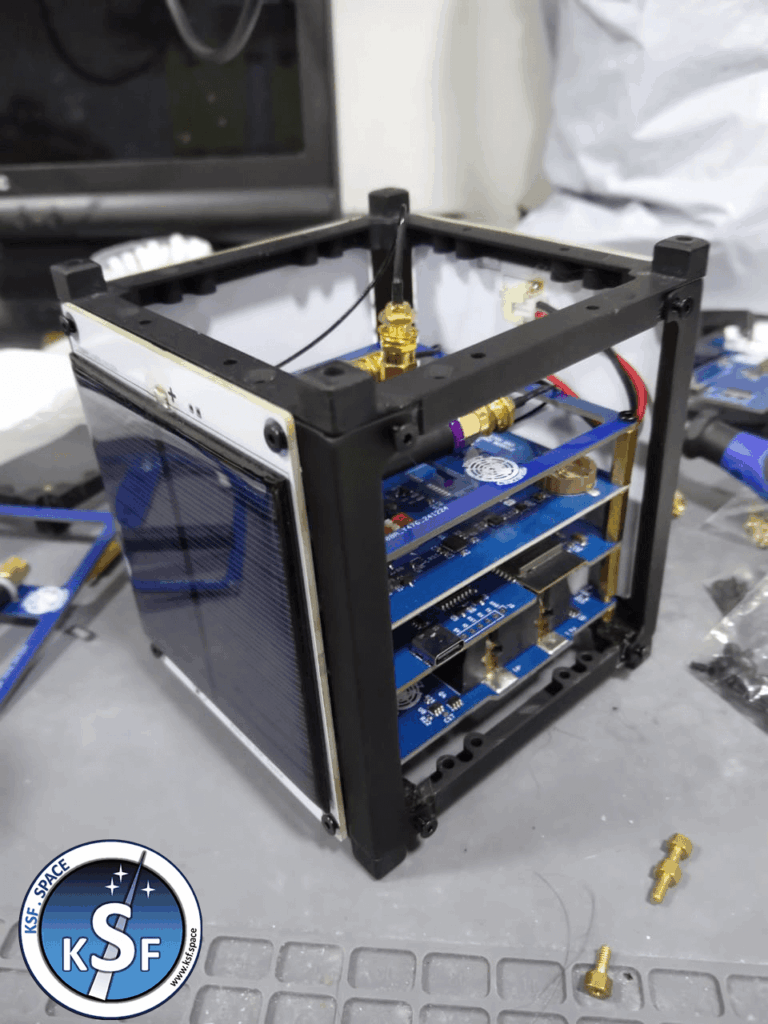
The KSF Space Cubesat isn’t just budget-friendly; it is a marvel of modern engineering. To achieve its status as the world’s cheapest Cubesat , KSF Space utilized advanced manufacturing and modular design.
1. Advanced Material Options: Aluminum and PA11
Depending on your mission profile, the Cubesat offers two primary structural materials:
- Aerospace-Grade Aluminum (6061-T6/7075): Known for its durability and thermal conductivity, acting as a heat sink for high-power electronics.
- PA11 (Polyamide 11): An innovative, bio-sourced polymer that is 40% lighter than aluminum. This version of the Cubesat is a game-changer for missions where every gram counts toward launch costs.
2. Comprehensive Sensor and Telemetry Suite
Each Cubesat comes equipped with essential instrumentation:
- Onboard Computers (OBC): The “brain” of your satellite.
- EPS (Electrical Power System): Managed solar panels and battery arrays.
- Sensors: Real-time data for temperature, pressure, altitude, GPS position, and 3-axis acceleration.
- Ground Station UI: A live interface to monitor your Cubesat telemetry remotely.
3. Flight-Proven Reliability
While the price is low, the standards are high. The Cubesat is developed and verified under the NASA-GSFC-STD-7000 (GEVS) framework, ensuring it can withstand the intense vibrations of a rocket launch (Max-Q).
How the Cubesat Kit is Democratizing Space for Universities
One of the most significant impacts of the KSF Space Cubesat is its adoption by academic institutions worldwide. It has been sold to many clients and universities that previously could not afford space research.
Moving from Theory to Hands-on Mission Success
Historically, aerospace students focused on theoretical physics because the hardware was too expensive to touch. The Cubesat changes that. Because it is affordable, universities can now fund satellite programs through recurring teaching funds rather than competitive research grants.
By integrating the Cubesat into their curriculum, students gain practical experience in:
- Firmware Development: Coding in C++ or Python for orbital operations.
- Thermal Management: Understanding how a Cubesat behaves in a vacuum.
- Mission Integration: The physical assembly of a 1U, 2U, or 3U satellite frame.
Why Choose the KSF Space Cubesat Kit Over Competitors?
When searching for a Cubesat Kit, reliability and cost are the two biggest factors. Here is how KSF Space stacks up:
| Feature | KSF Space Cubesat Kit | Traditional Competitors |
|---|
| Price Point | $5,000 USD (Starting Price) | Typically $15,000 – $50,000 |
| Flight Readiness | Suborbital Ready-to-Flight Model | Often Prototyping Only |
| Upgrade Path | Fully Upgradable to Orbital | Fixed / Limited |
| Lead Time | 1–2 Weeks (Off-the-shelf) | 6–12 Months (Custom) |
Technical Specifications: A Closer Look at the Cubesat Kit v2.0
The latest iteration, the Cubesat v2.0, is specifically engineered for the 2026 mission timeline.
Dimensions: Standard 1U (10cm x 10cm x 11.3cm).
Weight: Approximately 400g (varies by payload).
Power Consumption: 200 mW average.
Operating Temperature: Tested from -20°C to 50°C.
Communication: 433 MHz frequency bandwidth with two more transmission capabilities.
The modularity of the Cubesat allows for easy expansion. If your mission grows, you can easily transition from a 1U frame to a 2U or 3U configuration without relearning the entire system architecture.
Frequently Asked Questions (FAQ)
Is the KSF Space Cubesat Kit really the cheapest in the world?
Yes. At a starting price of $5,000 USD, it is currently the lowest-cost professional-quality Cubesat Kit on the planet.
Is the kit flight-ready?
Absolutely. Every Cubesat is a suborbital ready-to-flight model. It is built to survive the mechanical and atmospheric stresses of suborbital missions right out of the box.
Can I upgrade my kit for an orbital mission?
Yes. One of the primary advantages of the KSF Space Cubesat is its scalability. You can upgrade your suborbital model to a full orbital-qualified version as your mission requirements and budget grow.
Do I need to be an aerospace engineer to use the kit?
No. The Cubesat is designed with a user-friendly interface and step-by-step instructions. It is widely used for STEM education to introduce students to satellite design.
Conclusion: Start Your Space Journey Today
The mission of KSF Space is to democratize the stars. By providing a $5,000 USD professional Cubesat , they have opened the door for thousands of new researchers and explorers to contribute to our understanding of the universe.
Whether you are building your first “FlatSat” prototype on a workbench or preparing a 3U constellation for a SpaceX rideshare, the Cubesat is the reliable, cost-effective, and flight-ready foundation you need.
Contact Information
For technical quotes, university partnerships, or mission integration details, reach out to the KSF Space team: