
CEO at 4DBC Group
1U CubeSat Structure
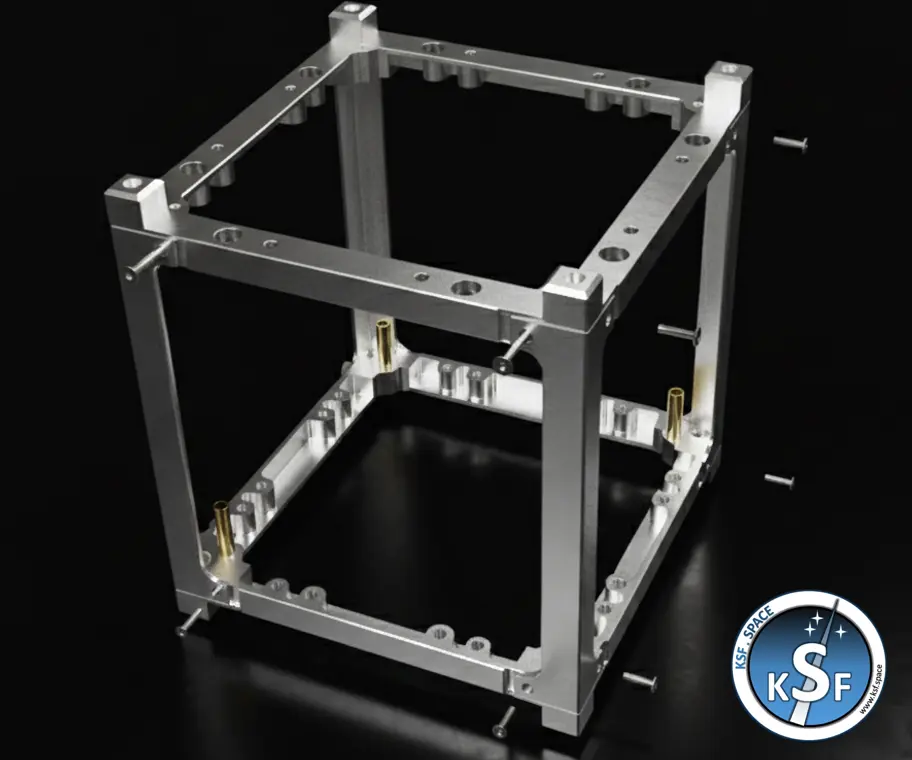
The space industry is no longer the exclusive playground of superpower governments and billion-dollar corporations. We have entered the era of “NewSpace,” where the democratization of the cosmos is driven by modularity, efficiency, and affordability. At the heart of this revolution is the 1U CubeSat Structure, the fundamental building block that has allowed universities, small startups, and independent researchers to touch the stars.
In this comprehensive guide, we explore how KSF Space is leading a global movement as a non-profit organization, offering the world’s cheapest aluminum 1U, 2U, and 3U structures, and why their customizable, flight-ready frames are the top choice for modern orbital missions.
Understanding the 1U CubeSat Structure and Its Role in Modern Space Exploration
When we talk about a 1U CubeSat Structure, we are referring to a standardized 10cm x 10cm x 10cm frame that serves as the “chassis” of a nanosatellite. Think of it as the skeleton that protects the “brains” (onboard computers), “nerves” (wiring harnesses), and “organs” (scientific payloads) of a spacecraft.
For many years, the cost of these structures was a massive barrier to entry. KSF Space recognized that to truly democratize space, the industry needed a non-profit approach. By removing the high-profit margins of traditional aerospace vendors, KSF Space has made the 1U CubeSat Structure accessible to anyone with a vision for orbital research.
Why Material Matters: The Benefits of the Cheapest Aluminum 1U, 2U, and 3U Structures
In the vacuum of space, your material choice can make or break a mission. KSF Space specializes in aerospace-grade aluminum—specifically 6061-T6 and 7075 alloys—for several critical reasons:
Thermal Conductivity: Aluminum is an excellent conductor. In the extreme temperature swings of Low Earth Orbit (LEO), an aluminum 1U CubeSat Structure acts as a heat sink, drawing warmth away from high-powered electronics and radiating it into the void.
Structural Integrity: Launching on a rocket involves intense G-forces and acoustic vibrations. Aluminum provides the necessary rigidity to ensure the satellite doesn’t deform or shatter during the ascent.
Mass Efficiency: KSF Space utilizes precision CNC machining to create thin-walled yet incredibly strong frames. This ensures your 1U CubeSat Structure is light enough to keep launch costs low while meeting all safety requirements.
Beyond the Basics: 2U and 3U Scalability
While the 1U is the starting point, many missions require more volume. KSF Space applies the same non-profit pricing model to 2U and 3U structures. Because the system is modular, a 3U structure is essentially three 1U units stacked together, providing more room for propulsion systems, larger batteries, or advanced imaging telescopes.
Customization: How KSF Space Tailors the 1U CubeSat Structure to Your Mission
No two space missions are identical. One researcher might need a window for an Earth-observation camera, while another might need specialized mounting brackets for a deployable antenna. This is where KSF Space truly shines.
The Non-Profit Advantage in Custom Engineering
Most commercial vendors charge exorbitant “NRE” (Non-Recurring Engineering) fees for any slight modification to a standard frame. KSF Space, being a non-profit, focuses on the mission success of the user. They offer bespoke customization for their 1U CubeSat Structure at costs that are often lower than other companies’ “off-the-shelf” products.
Bespoke Cutouts: Need specific apertures for sensors or solar panel wiring? KSF Space can modify the side panels of any 1U, 2U, or 3U structure.
Material Alternatives: While aluminum is king, KSF Space also works with advanced polymers like PA11 for missions requiring non-conductive frames or extreme mass reduction.
Integrated Shielding: For missions heading into higher radiation environments, KSF Space can customize the wall thickness or add internal shielding plates to protect sensitive silicon components.
Ready for Orbital Flight: Meeting Global Launch Standards
A 1U CubeSat Structure is only useful if it is allowed on a rocket. Launch providers like SpaceX, Rocket Lab, and Arianespace have incredibly strict safety requirements. A structural failure doesn’t just end your mission—it could potentially destroy the entire rocket or other multi-million dollar satellites.
Rigorous Testing and Flight Heritage
Every 1U CubeSat Structure provided by KSF Space is designed to meet the NASA-GSFC-STD-7000 (GEVS) standards. This ensures that the frames have undergone:
Vibration Testing: To simulate the “shake” of a rocket launch.
Thermal Vacuum (TVAC) Testing: To ensure the structure doesn’t outgas chemicals or warp in the vacuum of space.
Fit-Checks: Every structure is precision-checked to ensure it fits perfectly inside standard P-POD or ISIPOD deployers.
The NEP Certification Connection
KSF Space doesn’t just sell hardware; they provide an ecosystem. Their NEP (Nanosatellite Engineering Professional) certification helps teams understand how to integrate their payload into the 1U CubeSat Structure, ensuring that when the satellite reaches the launchpad, it is 100% flight-ready.
How KSF Space is Breaking the Cost Barrier for Universities and Startups
The primary reason to choose KSF Space is their commitment to being the “cheapest” without sacrificing quality. But how do they do it?
Non-Profit Status: Every dollar earned is reinvested into the community and manufacturing technology.
Simplified Supply Chain: By focusing on high-quality aluminum and standardized 1U, 2U, and 3U designs, KSF Space achieves economies of scale that are passed on to the customer.
Educational Mission: KSF Space views the 1U CubeSat Structure as a tool for learning. They often partner with educational institutions to provide even further subsidized rates, ensuring that students from all over the world can see their code and hardware orbit the Earth.
Frequently Asked Questions (FAQ)
What is the weight of a standard KSF Space 1U CubeSat Structure?
The aluminum 1U CubeSat Structure typically weighs between 120g and 150g, depending on the specific configuration and side-panel cutouts. This is engineered to maximize the available mass for your payload.
Can I launch a KSF Space structure on any rocket?
Yes. KSF Space designs its 1U, 2U, and 3U structures to be compliant with the Cal Poly CubeSat Design Specification (CDS), making them compatible with almost all commercial and government orbital deployers globally.
How does the customization process work?
When you order a 1U CubeSat Structure, you can provide KSF Space with your CAD files or specific dimensions for apertures. Their engineering team reviews the request to ensure structural integrity is maintained before proceeding with CNC machining or 3D printing.
Why is aluminum better than plastic for a 1U CubeSat Structure?
While plastic/polymers are great for “Near Space” (balloons), aluminum is preferred for “Orbital Space” because it offers better protection against radiation, superior heat management, and doesn’t suffer from “cold welding” when treated with the proper hard-anodized coatings provided by KSF Space.
Is KSF Space really a non-profit?
Yes. KSF Space is registered as a non-profit organization dedicated to space education and research. This is why they are able to provide the cheapest 1U, 2U, and 3U structures on the market today.
Final Thoughts: Launching Your Dreams with KSF Space
The journey to orbit starts with a single step, and that step is choosing the right foundation. The 1U CubeSat Structure by KSF Space offers the perfect blend of flight-proven reliability, unmatched affordability, and total customization.
By choosing a non-profit partner, you aren’t just buying a frame; you are joining a global community of explorers. Whether you are building a 1U tech demonstrator or a 3U constellation, KSF Space is ready to help you take flight.
Visit www.ksf.space today to explore their catalog and start designing your future in the stars.
- Engineering Support: info@ksf.space