
CEO at 4DBC Group
Cubesat Certification
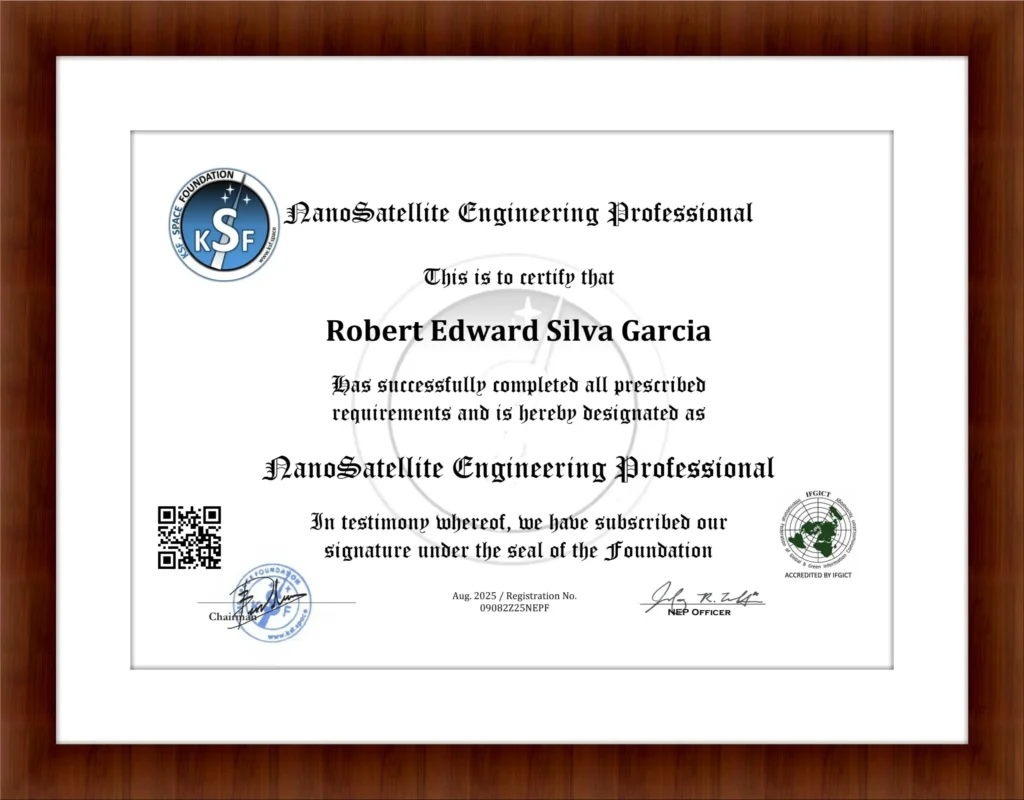
In the rapidly evolving landscape of the “NewSpace” era, the demand for qualified satellite engineers has never been higher. As space technology becomes more accessible to startups, universities, and developing nations, the need for standardized, professional validation is critical to ensure mission success. The Cubesat Certification by KSF Space has emerged as the global benchmark for professionals aiming to master the intricacies of nanosatellite engineering.
Whether you are an aspiring aerospace student, a researcher, or a seasoned professional engineer, obtaining a cubesat Certification is the definitive step toward career advancement in the modern space sector.
Why Cubesat Certification is Essential for Career Growth
Orbital logistics have reached a turning point. With reusable rockets and the deployment of massive IoT constellations, the barrier to entry for space has dropped, but the barrier to mission success remains high. A cubesat Certification ensures that individuals possess the technical rigor required to design, build, and operate satellites that can withstand the harsh realities of Low Earth Orbit (LEO).
The Global Standard for Nanosatellite Engineering
KSF Space pioneered the Nanosatellite Engineering Professional (NEP) program to bridge the gap between academic theory and orbital reality. This cubesat Certification is not just a digital badge; it is a comprehensive curriculum developed by veterans of the aerospace industry to meet the actual needs of the workforce.
What You Will Learn: The NEP Program Curriculum
The cubesat Certification offered by KSF Space covers the entire lifecycle of a satellite mission. Unlike general aerospace degrees, this program focuses specifically on the “U” standard (1U, 2U, 3U, and 6U) that defines the modern small-sat industry.
1. Mission Design and Orbital Mechanics
Understanding how to plot a trajectory is fundamental to any mission. The cubesat Certification dives deep into:
Keplerian Elements: Mastering the mathematics behind stable orbits.
Launch Windows: Coordinating with primary payloads for rideshare opportunities.
Mission Objectives: Defining payload requirements for Earth observation, climate monitoring, or telecommunications.
2. Spacecraft Subsystems and Integration
A CubeSat is a complex “system of systems” packed into a very small volume. To earn your cubesat Certification, you must demonstrate expertise in:
EPS (Electrical Power Systems): Managing solar arrays, power distribution units, and battery discharge cycles.
OBC (On-Board Computer): Programming flight software for radiation-hardened environments.
ADCS (Attitude Determination and Control System): Ensuring your satellite points in the right direction using magnetorquers, star trackers, or reaction wheels.
3. Structural Integrity and Thermal Management
The KSF Space curriculum emphasizes the physical survival of the satellite. Students learn about the NASA-GSFC-STD-7000 (General Environmental Verification Standard) framework, ensuring their designs can survive the “Max-Q” phase of launch and the extreme temperature swings in vacuum.
The Benefits of Getting Certified by KSF Space
Choosing KSF Space for your cubesat Certification provides unique advantages that other educational platforms cannot match, particularly regarding industry credibility.
Access to Flight Heritage and Testing Platforms
KSF Space is well-known for its “Near-Space” testing and suborbital rocket platforms. By pursuing this cubesat Certification, you align yourself with an organization that has actual flight heritage. This gives your resume instant credibility with employers like SpaceX, Blue Origin, and major space agencies.
Industry Recognition and Networking
With thousands of certified professionals globally, the KSF Space alumni network is a powerhouse of talent. Holding a cubesat Certification signals to recruiters that you possess the specialized knowledge to hit the ground running without the need for extensive on-the-job training.
Technical Mastery: From 1U to 3U Structures
A major component of the cubesat Certification involves understanding the mechanical constraints of the CubeSat form factor. KSF Space provides detailed instruction on:
Material Selection: Why Aluminum 6061-T6 is the gold standard for structural integrity and thermal conductivity.
3D Printing for Space: Utilizing advanced polymers for mass reduction and rapid prototyping.
Anti-Cold Welding: Applying hard-anodized coatings to rails to prevent the satellite from fusing to the P-POD (Poly-Picosatellite Orbital Deployer).
How to Apply for Cubesat Certification
The process for obtaining your cubesat Certification is designed to be accessible yet rigorous, ensuring only the most dedicated engineers qualify.
Enrollment: Register via the KSF Space official portal to access the learning management system.
Self-Paced Learning: Study the ten core modules covering everything from space policy to electric propulsion.
The Examination: Pass the comprehensive Nanosatellite Engineering Professional (NEP) exam with a minimum score of 75%.
Credentialing: Receive your official cubesat Certification and join the global registry of qualified space professionals.
Frequently Asked Questions (FAQ)
What is the primary focus of the KSF Space Cubesat Certification?
The primary focus is to provide a standardized professional qualification that covers the end-to-end design, engineering, testing, and operation of nanosatellites.
Is the certification recognized by major space agencies?
Yes, the NEP program is developed in alignment with international standards used by organizations like NASA and ESA. Many KSF Space members and advisors come from these backgrounds.
Can I get a Cubesat Certification online?
Absolutely. KSF Space offers a robust online curriculum to ensure that engineers and students worldwide can access the cubesat Certification regardless of their geographic location.
Does the program include hardware training?
While the cubesat Certification is a theoretical and technical validation of expertise, KSF Space also offers physical CubeSat hardware kits and balloon launch services that complement the learning modules for hands-on experience.
Contact Information
For more information about the program or to inquire about group enrollments for universities and corporate teams, please reach out to the KSF Space administration:
Email: info@ksf.space
Official Website: www.ksf.space