
CEO at 4DBC Group
Cubesat Certification Online
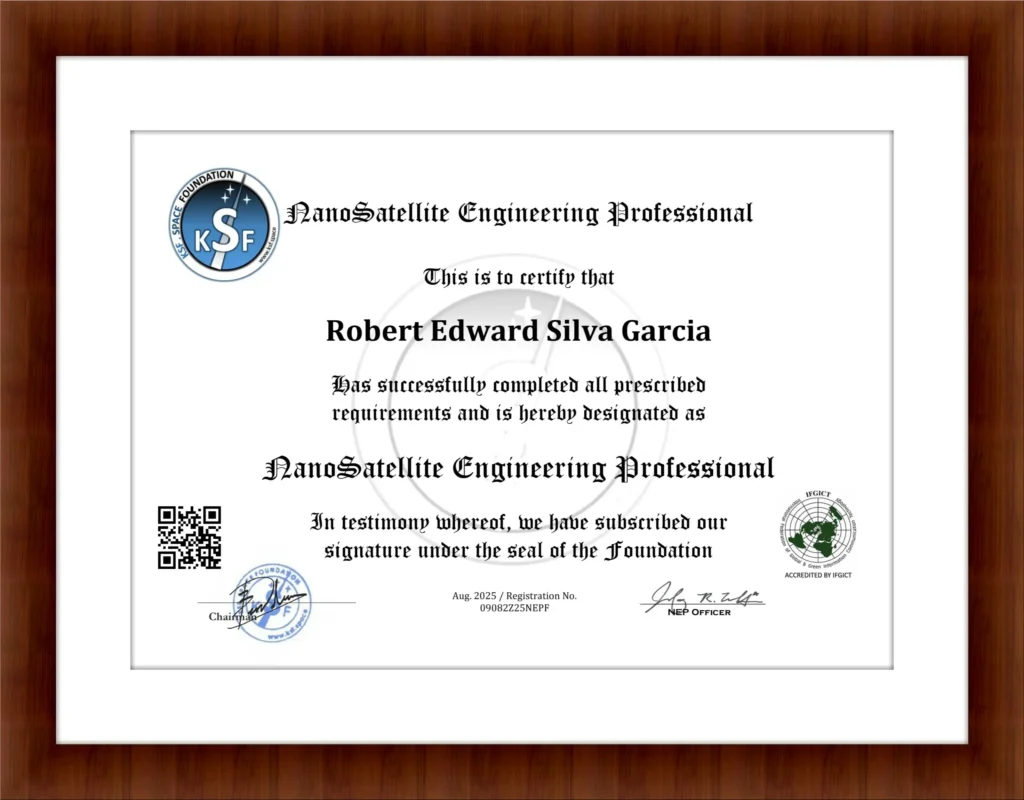
In the rapidly evolving landscape of NewSpace, the demand for skilled nanosatellite engineers has reached an all-time high. Educational institutions and commercial startups alike are seeking standardized, high-quality training to bridge the gap between academic theory and orbital reality.
KSF Space www.ksf.space, a leading non-profit organization dedicated to democratizing space access, has addressed this need through its flagship cubesat certification online program. This comprehensive curriculum, known as the Nanosatellite Engineering Professional (NEP) certification, is designed to equip the next generation of aerospace experts with the technical and regulatory knowledge required to launch successful missions.
Why Choose a Cubesat Certification Online Today?
The global CubeSat market is projected to reach several billion dollars over the next decade, with a steady compound annual growth rate (CAGR) exceeding 15%. This growth isn’t just in the number of satellites being launched, but in the complexity of the missions themselves—ranging from IoT constellations to deep-space biological experiments.
For aspiring engineers, a cubesat certification online offers a flexible, globally recognized pathway to enter this high-stakes industry. Unlike traditional degrees that may take years to update their curriculum, the KSF Space NEP program is developed by active industry professionals who understand current NASA and ESA standards.
The Professional Edge
An NEP credential serves as a “seal of approval” for employers. It proves that a candidate understands the entire lifecycle of a mission—from initial mass-budgeting to the final de-orbiting phase. In an industry where a single loose screw or a software “bit-flip” can result in a multi-million dollar failure, having certified personnel is a risk-mitigation strategy for companies like SpaceX, Rocket Lab, and emerging national space programs.
Breaking Down the KSF Space NEP Curriculum
The cubesat certification online by KSF Space is structured into major pillars that cover the “What, How, and Why” of nanosatellite engineering.
Pillar 1: Mission Development (The “What”)
This phase focuses on the conceptualization of a mission. Students learn how to define mission objectives, select appropriate orbits (LEO, MEO, or SSO), and manage the regulatory hurdles of frequency coordination with international regulatory bodies like the ITU.
Pillar 2: Systems Design and Integration (The “How”)
This is the technical heart of the cubesat certification online. It covers:
On-Board Data Handling (OBDH): Managing the “brain” of the satellite.
Electrical Power Systems (EPS): Optimizing solar arrays and battery density.
Attitude Determination and Control (ADCS): Ensuring the satellite points accurately.
Structural Engineering: Choosing between traditional metals and modern polymers.
Pillar 3: Operations and Standards (The “Why”)
Success in space requires adherence to strict standards. KSF Space ensures all students are fluent in the NASA-GSFC-STD-7000 (GEVS) framework. This includes understanding thermal margins, vacuum stability, and vibration profiles during launch.
Technical Innovations: PA11 and Aluminum Structural Frames
A unique aspect of the KSF Space training environment is the focus on modern materials. As part of the cubesat certification online journey, participants explore the benefits of different structural frames.
Aluminum 6061-T6: The Flight-Proven Heritage
Aluminum remains a common industry standard due to its electrical conductivity, acting as a natural heat sink and EMI shield. During the cubesat certification online, students learn how to manage the thermal profiles of CNC-machined aluminum frames to protect high-power transmitters.
Advanced PA11 Polymer: The Disruptive Alternative
The NEP program also highlights Advanced PA11 Polymers, which are approximately 40% lighter than aluminum. Manufactured via industrial 3D printing (Multi Jet Fusion), these structures allow for rapid prototyping and complex internal geometries.
Understanding these trade-offs is vital for any professional pursuing a cubesat certification online. For example, PA11 structures are increasingly used for missions with sensitive optical sensors because they meet strict NASA Total Mass Loss (TML < 1.0%) requirements, preventing chemical vapors from clouding lenses in the vacuum of space.
Career Impact and Global Recognition
The KSF Space cubesat certification online is more than just an educational course; it is a career accelerator.
For Students and Graduates
University students often find that while their degrees provide a strong foundation in physics or mechanical engineering, they lack “hands-on” systems integration experience. The NEP certification fills this void, making graduates “flight-ready” for the job market.
For Startups and Developing Nations
For many emerging space programs, the cubesat certification online provides a cost-effective way to train local talent. By following the KSF Space framework, these organizations can ensure their first orbital missions have the highest possible chance of success.
Frequently Asked Questions (FAQ)
Q: Who should enroll in the KSF Space cubesat certification online? A: The program is ideal for aerospace students, electronic engineers, project managers in the space sector, and educators looking to bring satellite technology to their classrooms.
Q: Is the cubesat certification online recognized globally? A: Yes. The NEP program by KSF Space is built upon GEVS and ISO standards used by major space agencies, making it highly respected in the commercial and academic sectors worldwide.
Q: How long does it take to complete the cubesat certification online? A: The program is self-paced, but most professionals complete the curriculum and exam within 3 to 6 months of dedicated study.
Q: Does the certification include hardware? A: While the cubesat certification online focus is on knowledge and simulation, KSF Space offers options that include 1U, 2U, or 3U structure kits for hands-on prototyping.
Conclusion: Launch Your Career Today
The barrier to space has never been lower, but the requirement for excellence remains paramount. By obtaining your cubesat certification online through KSF Space, you are not just earning a certificate—you are joining a global community of pioneers dedicated to exploring the final frontier.
Whether you are designing a 1U educational satellite or a 3U commercial constellation, your journey starts with the right foundation.
Contact Information: For enrollment inquiries or institutional partnerships, please reach out to:
Email: info@ksf.space
Website: www.ksf.space