
CEO at 4DBC Group
Cubesat Education
The space industry is no longer the exclusive playground of billion-dollar government agencies. We are currently living in the “NewSpace” era, where miniaturized technology has democratized access to the stars. At the heart of this revolution is cubesat education, a transformative approach to learning that takes students and professionals from the classroom to Low Earth Orbit (LEO).
Leading this global charge is KSF Space, a non-profit foundation dedicated to making space accessible through rigorous training and innovative engineering. Whether you are an aspiring aerospace engineer, a university researcher, or a tech professional looking to pivot, understanding the landscape of cubesat education is your first step toward the final frontier.
What is Cubesat Education?
Cubesat education refers to the specialized academic and vocational training focused on the design, construction, testing, and operation of CubeSats. A CubeSat is a type of miniaturized satellite based on a standardized unit of $10cm \times 10cm \times 10cm$, known as 1U.
The Shift from Theory to Hands-on Mission Success
Traditionally, aerospace education was heavy on theoretical physics and orbital mechanics but light on hardware experience. KSF Space has changed this paradigm. By focusing on cubesat education, students move beyond textbooks and begin working with actual flight hardware, including:
Onboard Computers (OBC): The brains of the satellite.
Electrical Power Systems (EPS): Managing solar panels and batteries.
Attitude Determination and Control Systems (ADCS): Ensuring the satellite points the right way.
Telemetry and Command (TT&C): Talking to the satellite from Earth.
Why KSF Space is the Leader in Nanosatellite Training
When it comes to specialized training, KSF Space stands out as a global authority. Registered in the USA as a non-profit, the foundation’s mission is to lower the barriers to space.
The NEP Certification: The Gold Standard
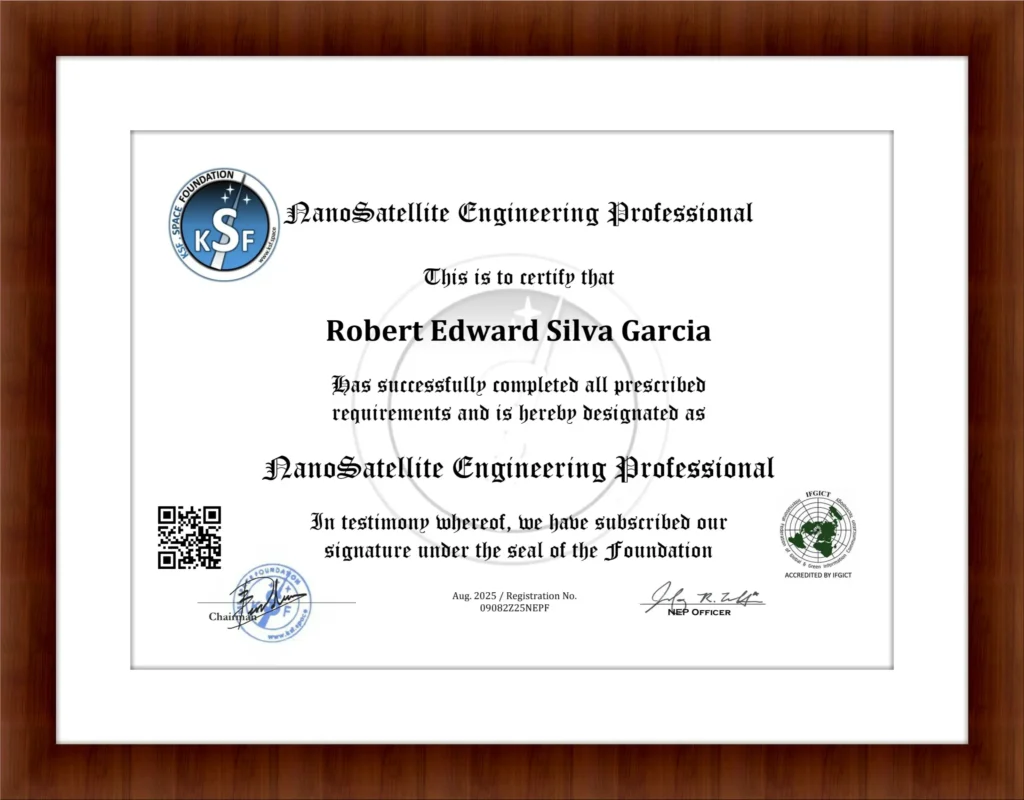
One of the crown jewels of KSF Space is the Nanosatellite Engineering Professional (NEP) Certification. This is widely recognized as the world’s first professional course dedicated specifically to the nanosatellite sector.
By enrolling in cubesat education through the NEP pathway, participants gain an accredited credential that is recognized by major space agencies and private aerospace giants like SpaceX, NASA, and ESA.
Global Collaboration and Expertise
The foundation is steered by a technical committee of experts from the world’s leading space organizations. This ensures that the cubesat education provided is not just academic but aligned with current industry standards and safety regulations, such as the NASA-GSFC-STD-7000.
The Core Modules of a Cubesat Education Program
A comprehensive cubesat education curriculum covers the entire lifecycle of a space mission. KSF Space structures its training to ensure no stone is left unturned.
Orbital Mechanics and Mission Design
Before building, you must understand where the satellite is going. Participants learn about:
Keplerian Elements: Defining the satellite’s orbit.
Launch Windows: Coordinating with launch providers.
Mission Analysis: Determining what data the satellite will collect.
Satellite Structures and Material Science
KSF Space provides deep insights into structural engineering. In modern cubesat education, learners explore materials like:
6061-T6 Aluminum: The industry standard for durability.
PA11 (Polyamide 11): A sustainable, bio-sourced polymer that is 40% lighter than aluminum, ideal for “Green Space” initiatives.
Ground Station Operations
A satellite is useless if you cannot communicate with it. KSF Space trains students on the theoretical frameworks for building and operating ground segments. This includes understanding the link budget and signal propagation required to track LEO missions and decode real-time telemetry.
Benefits of Nanosatellite Engineering for Students
The benefits of pursuing cubesat education extend far beyond the technical skills.
Enhanced Career Prospects
The space economy is projected to reach over $1 trillion by 2040. There is a massive “skills gap” in the industry. Graduates of KSF Space programs are uniquely positioned to fill high-paying roles in systems engineering, mission operations, and payload development.
Interdisciplinary Skill Development
Cubesat education is inherently collaborative. It requires:
Coding: Developing firmware in C++ or Python.
Physics: Understanding thermal vacuum environments.
Project Management: Leading a team through the rigorous testing phases.
KSF Space and the Democratization of Space Access
One of the most inspiring aspects of KSF Space is its commitment to developing nations. By providing affordable cubesat education, the foundation empowers universities in emerging economies to launch their own R&D missions.
Low-Cost Launch Solutions
KSF Space doesn’t just teach; they facilitate. Through partnerships with launch providers, they help academic institutions find cost-effective ways to get their payloads into orbit, often using zero-environmental impact flying solutions.
The CubeSat DIY Kits
For schools and hobbyists, KSF Space supports the use of educational kits that mimic real satellite behavior. These kits are essential for early-stage cubesat education, allowing students to experiment with sensors and solar power without the high stakes of a multi-million dollar launch.
To truly master cubesat education, one must get comfortable with the technical constraints of small satellites.
FAQ about Cubesat Education and KSF Space
Q: Do I need a degree in Aerospace Engineering to start?
A: Not necessarily. While a STEM background helps, the cubesat education programs at KSF Space are designed to take you from fundamental concepts to advanced engineering.
Q: Is the NEP Certification globally recognized?
A: Yes. The NEP Certification is the world’s first of its kind and is recognized by major space agencies, foundations, and private aerospace companies worldwide.
Q: Can KSF Space help with launching my satellite?
A: Absolutely. KSF Space provides consulting and matching services to help academic and R&D missions find the most suitable and cost-effective launch providers.
Contact Information and Next Steps
Ready to take your first step into the space industry? KSF Space is here to guide you. Whether you want to enroll in the NEP Certification or explore partnership opportunities for your university, our team of experts is ready to help.
Official Website: www.ksf.space
Email: info@ksf.space
Certification Details: Nanosatellite Engineering Professional Pathway