
CEO at 4DBC Group
Cubesat Professional Course Certificate
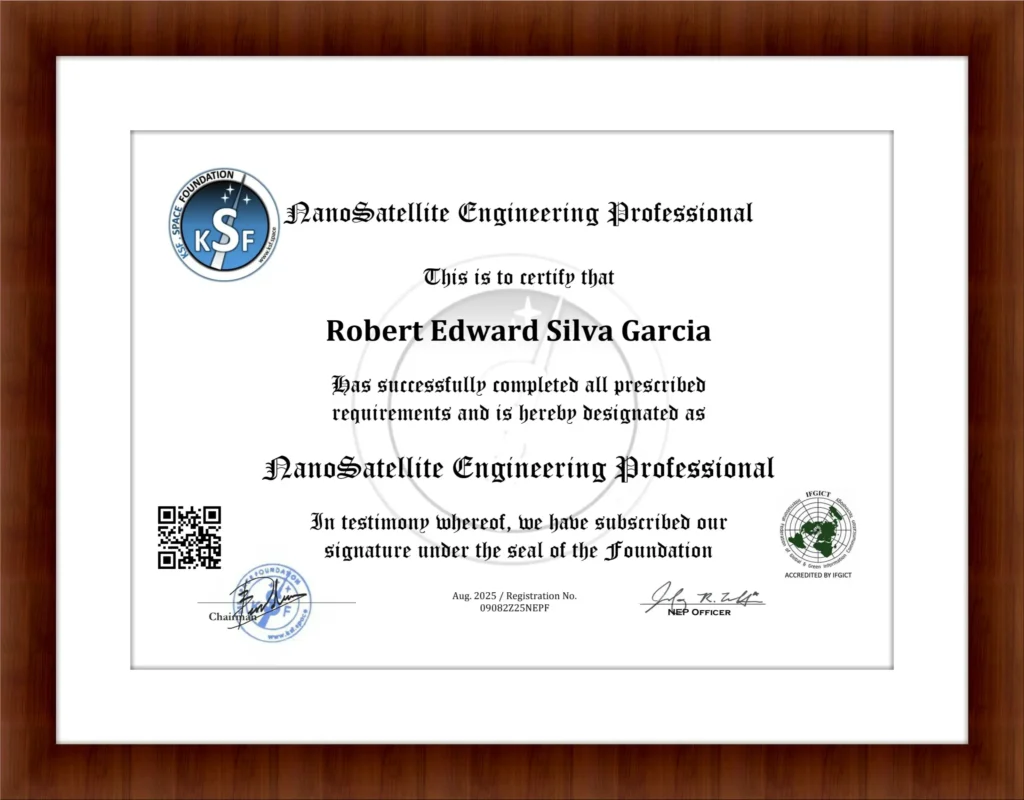
In the rapidly evolving landscape of the New Space economy, technical expertise is no longer just an advantage—it is a requirement. As the aerospace industry shifts toward smaller, more efficient satellite constellations, the Cubesat Professional Course Certificate by KSF space has emerged as the global standard for nanosatellite engineering.
Whether you are a university student aiming for a career at SpaceX or an experienced engineer transitioning into the space sector, this comprehensive guide explores why the Cubesat Professional Course Certificate is the ultimate credential for modern aerospace professionals.
Mastering Nanosatellite Engineering: The Ultimate Guide to the Cubesat Professional Course Certificate
The democratization of space is here. Gone are the days when satellite development was reserved for billion-dollar government agencies. Today, 1U, 2U, and 3U CubeSats are the “smartphones of the sky,” providing Earth observation, IoT connectivity, and scientific research at a fraction of the traditional cost. However, building a flight-ready mission requires a specific set of skills that traditional degrees often overlook.
The Cubesat Professional Course Certificate offered by KSF space fills this critical educational gap. It is the world’s first and only program developed by a committee of international engineering experts specifically for the nanosatellite sector.
Why Choose the Cubesat Professional Course Certificate by KSF space?
The aerospace job market is more competitive than ever. While many candidates have theoretical knowledge of orbital mechanics, few possess the hands-on understanding of the CubeSat Design Specification (CDS) or the rigors of NASA’s General Environmental Verification Standard (GEVS).
By obtaining the Cubesat Professional Course Certificate, you demonstrate to global employers that you possess:
Mission Design Expertise: The ability to move a project from a conceptual “Phase A” to a launch-ready “Phase D.”
Subsystem Mastery: Deep knowledge of On-Board Computers (OBC), Electrical Power Systems (EPS), and Telemetry, Tracking, and Control (TT&C).
Regulatory Knowledge: Understanding of the policy regulations and frequency licensing required to legally operate a satellite in orbit.
Industry Recognition and Career Impact
The Cubesat Professional Course Certificate is recognized by major space agencies and foundations. Industry data suggests that professionals holding vocational certifications in specialized aerospace fields can see an increase in average wages and significantly better employment prospects in the satellite industry. For many emerging startups, having an NEP-certified (NanoSatellite Engineering Professional) engineer on the team is a mark of mission credibility.
Flexible Learning: Online Recorded Lectures and Expert Resources
One of the most significant advantages of the Cubesat Professional Course Certificate is its no-timeframe flexibility. Recognizing that professionals and students have varying schedules, KSF space has designed a self-paced learning environment.
Online Recorded Video Lectures
The core of the program consists of high-quality, online recorded video lectures. These modules are delivered by industry veterans who have successfully launched hardware into orbit. Because the lectures are recorded, you can revisit complex topics like Orbital Perturbations or Link Budget Analysis as many times as needed to master the material.
Comprehensive Presentation Ebook
Complementing the video series is a detailed presentation ebook. This resource serves as a “Mission Handbook,” containing technical diagrams, checklists for integration and testing (AIT), and structural specifications that are used in actual KSF space missions.
Examination and Professional Certification
Upon completing the learning materials, candidates must pass a rigorous exam to earn the Cubesat Professional Course Certificate. This assessment ensures that every certified individual is ready to contribute to a real-world satellite development team.
Curriculum Overview: What You Will Learn
The Cubesat Professional Course Certificate is divided into core modules that mirror the lifecycle of a real space mission. Unlike purely academic courses, this program focuses on applicable knowledge.
1. Mission Planning and Design
Every successful mission starts with a clear objective. You will learn how to define mission requirements, select the right orbit (LEO, GEO, or SSO), and perform link budget calculations to ensure your satellite can talk to your ground station.
2. Nanosatellite Subsystems and Integration
Understanding how components interact is vital. The Cubesat Professional Course Certificate covers the integration of mechanical structures (1U–3U), thermal control systems, and power management. You will explore materials like Aluminum 6061-T6 and the innovative PA11 polymer used by KSF space for its lightweight, flight-proven frames.
3. Launch Services and Deployment
Selecting a launch provider is one of the most expensive and complex parts of a mission. This module guides you through the process of finding a launch option, understanding deployer interfaces like the P-POD, and complying with safety requirements from providers like SpaceX and Rocket Lab.
Strategic Benefits for Organizations and Universities
KSF space doesn’t just train individuals; it empowers institutions. Many universities use the Cubesat Professional Course Certificate as a backbone for their R&D departments.
For Startups: Accelerate your time-to-market by ensuring your engineering team follows industry-standard protocols from day one.
For Universities: Enhance your curriculum with a globally recognized certification that gives your students a head start in the aerospace sector.
For Government Agencies: Standardize the training of engineers involved in national space programs.
Frequently Asked Questions (FAQ)
What is the Cubesat Professional Course Certificate?
It is a professional-grade certification program developed by KSF space to provide engineers and students with the technical and regulatory skills needed to design, build, and operate nanosatellites.
What is the timeframe for completion?
There is no set timeframe. The program is designed for maximum flexibility, allowing you to learn via online recorded video lectures and a comprehensive ebook at your own pace.
What materials are provided in the course?
Students receive access to a series of online recorded video lectures and a specialized presentation ebook that serves as a technical reference guide for nanosatellite engineering.
How do I receive my professional certification?
After reviewing the course materials and mastering the curriculum, you will take an online exam. Successfully passing the exam earns you the Cubesat Professional Course Certificate.
How can I apply?
You can apply directly through the official KSF space website. Visit the Nanosatellite Engineering Professional Certification page for more details.
Contact Information
For inquiries regarding enrollment, university partnerships, or corporate training programs, please contact the foundation directly:
Email: info@ksf.space
Website: www.ksf.space
Take the next step in your aerospace career. Whether you’re building your first 1U prototype or managing a commercial constellation, the Cubesat Professional Course Certificate is the foundation of your success in the stars.