
CEO at 4DBC Group
KSF Space Achieves Prestigious ISO 17770:2017 Accreditation by IFGICT for CubeSat and Aerospace Education Excellence
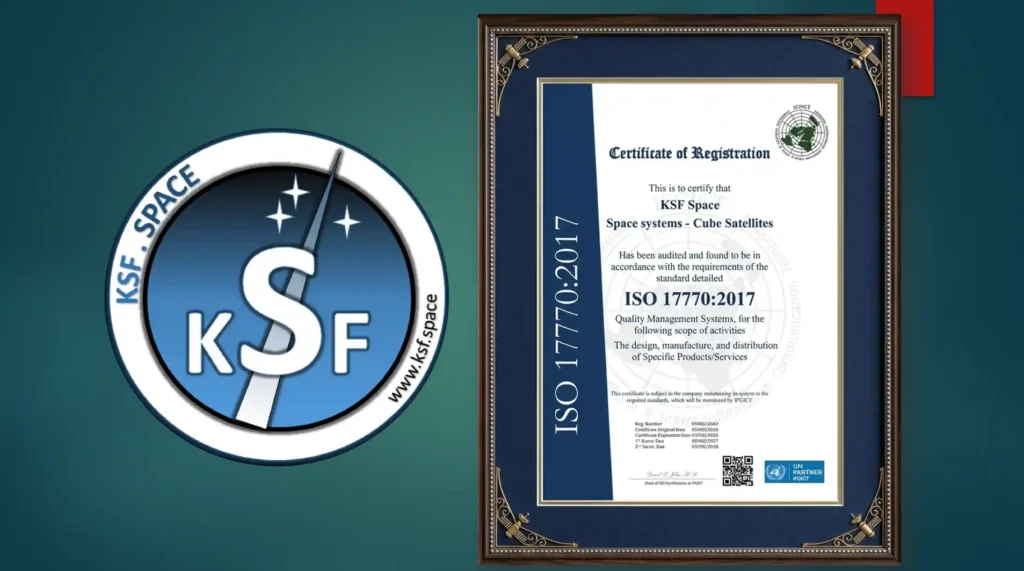
In an era where space exploration is rapidly transitioning from nation-state dominance to commercial, educational, and institutional access, standardization stands as the ultimate catalyst for safety, reliability, and global interoperability. Marking a major milestone for global aerospace education and small satellite research, KSF Space has officially been awarded the ISO 17770:2017 accreditation by the IFGICT (International Federation of Global Information and Communication Technology), the world’s leading federation and accreditation body in certifications.
This prestigious distinction cements KSF Space‘s position as an international pioneer in STEM education, nanosatellite research, and practical aerospace training for universities, colleges, research institutes, and professional engineering programs worldwide. By aligning its educational frameworks, satellite design specifications, and mission launch preparation workflows with the rigorous mandates of Cubesat ISO 17770:2017, the organization provides students and faculty with an accredited, industry-grade launchpad into orbital engineering.
What is ISO 17770:2017 for Space Systems and CubeSats?
The Technical Definition of ISO 17770:2017
Developed by the International Organization for Standardization (ISO), ISO 17770:2017 specifies the physical, mechanical, electrical, operational, and interface requirements for CubeSats (1U to 12U+ form factors) and their integration with launch vehicles. As the universal benchmark for small satellite engineering, ISO 17770:2017 sets rigorous guidelines covering:- Dimensional and Mass Limits: Standardizing the unit volume (1U = $10\text{ cm} \times 10\text{ cm} \times 11.35\text{ cm}$) and mass constraints to ensure safe deployment.
- Mechanical and Structural Integrity: Ensuring structural frames withstand severe launch vibration, acoustic loads, and g-forces.
- Electrical and Electronic Safety: Mandatory inhibit switches, battery protection circuitry, and non-interfering radio frequency (RF) transmissions.
- Deployer Interface Requirements: Precise rail tolerances and contact point specifications to guarantee smooth release from Pod Deployers (e.g., P-POD) without jamming.
- Environmental and Debris Mitigation Compliance: Adherence to Low Earth Orbit (LEO) orbital decay timelines and passive deorbiting mechanisms to prevent space debris accumulation.
Understanding the Role of IFGICT in Global Standards and Accreditation
Who is IFGICT?
The International Federation of Global Information and Communication Technology (IFGICT) is the world’s foremost ICT federation, trusted by governments, multinational corporations, and higher education academic networks. IFGICT establishes international benchmarks across ICT, artificial intelligence, space communications, and advanced engineering certifications.Why the IFGICT ISO 17770:2017 Accreditation Matters for Universities and Colleges
For academia, transitioning from theoretical textbook lectures to hands-on satellite engineering involves navigating complex regulatory, technical, and financial hurdles. Without standardized guidelines, academic satellite projects frequently encounter mission failures, budget overruns, or rejection by launch service providers due to non-compliance with container deployment standards.Key Advantages for Higher Education Institutions
- Guaranteed Launch Compatibility: Satellites designed under Cubesat ISO 17770:2017 protocols meet the strict interface requirements of commercial rocket launch vehicles (including SpaceX, Rocket Lab, ISRO, and Arianespace).
- Reduced Mission Risk: Adhering to standardized electrical inhibit protocols and mechanical thermal tolerances minimizes risk to primary payloads and launch vehicles.
- Accredited Graduate Credentials: Students participating in KSF Space initiatives receive industry-recognized, IFGICT-backed credentials that validate their competency in space systems engineering.
- Streamlined Regulatory Approval: Standardized small satellite designs facilitate faster authorization from civil aviation, telecommunications (ITU, FCC), and national space agencies.
KSF Space: Pioneering Accessible Aerospace and STEM Education
Mission and Vision
KSF Space was established to democratize access to space science, technology, engineering, and mathematics (STEM). By providing affordable, hands-on, and flight-tested hardware platforms alongside comprehensive educational modules, the organization enables universities worldwide—regardless of budget size—to launch their own space programs.
From Near-Space to Low Earth Orbit: The Step-by-Step Learning Pathway
KSF Space offers an end-to-end hands-on learning ecosystem that allows students to progress from basic atmospheric science to complex orbital deployments:| Stage | Platform / Orbit | Primary Learning Objective |
|---|---|---|
| Stage 1: Atmospheric Proof-of-Concept | High-Altitude Balloons (30 km – 40 km / Stratosphere) | Thermal management, sensor telemetry, GPS tracking, zero-pressure environments. |
| Stage 2: Dynamic Launch Dynamics | Sounding Rockets (100 km+ / Suborbital) | High-G load stress analysis, microgravity payload operation, rapid data retrieval. |
| Stage 3: Orbital Deployment | 1U to 3U CubeSats (400 km – 600 km / LEO) | Long-duration power systems, ADCS, UHF/VHF/S-band communications, orbital mechanics. |
Detailed Analysis of CubeSat ISO 17770:2017 Technical Specifications
To fully grasp the significance of this award, it is essential to examine the core technical requirements that Cubesat ISO 17770:2017 enforces and how KSF Space incorporates them into its curriculum.1. Mechanical Form Factor and Deployment Rails
- Dimensional Accuracy: All standard units ($1\text{U}, 2\text{U}, 3\text{U}, 6\text{U}$) must maintain tight tolerances ($\pm0.1\text{ mm}$) along rail surfaces to prevent bind-up inside the deployer mechanism.
- Surface Treatment: Hard-anodized aluminum alloys (e.g., Al 6061-T6 or Al 7075) are required on outer rail contact points to eliminate cold welding risks in vacuum conditions.
- Center of Mass Constraints: The center of mass must remain within strict millimeter offsets from the geometric center to maintain balance during launch ejects.
2. Electrical Systems and Safety Inhibits
- Three-Level Inhibit Requirement: The electrical power supply (EPS) must feature at least three independent mechanical deployment switches (plunger switches) that keep the satellite completely powered off while inside the deployer.
- RF Transmission Timers: Transmitters must remain silenced for a minimum of 30 minutes following deployment into orbit to avoid interference with the launch vehicle or neighboring satellites.
- Battery Safety Isolation: Lithium-ion or LiFePO4 chemistry cell packs must include protection against thermal runaway, short circuits, overcharging, and deep discharge under high vacuum environments.
3. Thermal and Vacuum Environmental Testing
- Thermal Vacuum Testing (TVAC): Spacecraft hardware must undergo thermal cycling in vacuum chambers operating between $-40^\circ\text{C}$ and $+85^\circ\text{C}$.
- Vibration and Acoustic Load Profiles: Hardware undergoes random and sinusoidal vibration testing to simulate launch acoustics and separation shock.
How Universities Can Implement ISO 17770:2017 into Engineering Programs
Integrating space engineering into higher education curricula requires structured modules that balance theoretical foundations with hands-on laboratory experiences. 4-YEAR UNIVERSITY AEROSPACE CURRICULUM ROADMAP
Year 1: Aerospace Fundamentals & Systems Engineering
└── Introduction to Space Environment, Orbital Mechanics, & Electronics
Year 2: Hands-On Payload & Stratospheric Flight Testing
└── Near-Space Balloon Payload Design, Microcontroller Programming, Telemetry
Year 3: ISO 17770:2017 Compliant Hardware Integration
└── ADCS Design, Power Isolation, Cleanroom Protocols, Structural Analysis
Year 4: Orbital Mission Launch & Ground Station Operations
└── Launch Integration, UHF/S-Band Tracking, Real-Time Data Decoding
Step 1: Curriculum Alignment and Faculty Training
Universities partner with KSF Space to align existing electrical, mechanical, software, and systems engineering courses with IFGICT-accredited standards. Faculty members receive direct training on ISO quality assurance protocols and spaceflight safety mechanisms.Step 2: Cleanroom and Ground Station Setup
KSF Space assists universities in establishing affordable, operational space laboratories, including:- Class 100,000 (ISO 8) cleanrooms or clean benches for satellite assembly.
- VHF/UHF and S-band ground station stations equipped with automated tracking antennas for listening to active orbiting CubeSats.
Step 3: Stratospheric Prototype Testing
Prior to investing in orbital launches, university student teams build functional payloads and flight-test them via KSF Space‘s zero-pressure stratospheric balloon launches. This provides immediate, real-world data validation under vacuum-like conditions at $30\text{ km}$ altitude.Step 4: Orbital Launch Manifesting
Once a student-designed payload meets all Cubesat ISO 17770:2017 safety checks and vibration tests, KSF Space facilitates launch manifesting through partner launch providers, guiding the university from integration through to orbital deployment.Artificial Intelligence and IoT Integration in Modern Small Satellites
The convergence of Artificial Intelligence (AI), the Internet of Things (IoT), and small satellites is transforming Earth observation, environmental monitoring, and global communications.1. On-Board Processing and Edge Computing
Traditional satellites stream vast quantities of raw imagery to ground stations for processing, consuming precious bandwidth. Modern Cubesat ISO 17770:2017 designs incorporate low-power AI accelerators (e.g., edge TPU microprocessors) capable of:- Filtering cloud-covered imagery before transmission.
- Detecting ocean oil spills or deforestation events in real-time.
- Identifying natural disaster anomalies to trigger immediate emergency alerts.
2. Space-Based IoT Gateways
CubeSats operating in LEO can act as orbital relays for remote ground-based IoT devices in oceans, deserts, or polar regions where terrestrial cell towers do not exist. Standardized interfaces outlined by IFGICT ensure these communication payloads integrate cleanly with small satellite buses.Frequently Asked Questions (FAQ)
What is ISO 17770:2017 and why is it important for CubeSats?
ISO 17770:2017 is an international standard that defines the physical, mechanical, electrical, and operational requirements for standard unit small satellites (CubeSats) and their interface with deployment systems. It ensures satellite safety, mitigates space debris risks, and guarantees launch vehicle compatibility.Who awarded the ISO 17770:2017 accreditation to KSF Space?
The accreditation was awarded by the IFGICT (International Federation of Global Information and Communication Technology), a leading international accreditation body and federation in certification standards for ICT, engineering, and advanced technologies.How does KSF Space assist universities with small satellite projects?
KSF Space provides universities with IFGICT-accredited training programs, hands-on CubeSat kits, stratospheric balloon testing, suborbital flight tests, cleanroom advisory services, and access to commercial orbital launch opportunities.What is the standard size and mass of a 1U CubeSat under ISO 17770:2017?
A standard 1U CubeSat measures $10\text{ cm} \times 10\text{ cm} \times 11.35\text{ cm}$ and typically carries a maximum mass of up to 2.0 kg per unit, adhering strictly to deployment rail constraints.How can a university or college get started with KSF Space?
Higher education institutions can contact the KSF Space engineering team directly at info@ksf.space to discuss curriculum integration, faculty workshops, or payload launch partnerships.Summary and Next Steps
The recognition of KSF Space‘s compliance with ISO 17770:2017 by IFGICT represents a major advancement in global aerospace education. By providing universities with an accredited, safety-tested, and standardized path to orbit, KSF Space bridges the gap between academic theory and space exploration. Whether your institution seeks to establish an introductory STEM payload course, launch stratospheric research experiments, or deploy fully operational orbital Cubesat ISO 17770:2017 constellations, the KSF Space team offers turnkey support from concept to orbit.Contact Information
For institutional inquiries, university partnerships, media interviews, or satellite launch requests, please contact:- Organization: KSF Space
- Official Website: www.ksf.space
- Direct Email: info@ksf.space