
CEO at 4DBC Group
Small Satellite "SmallSat" Certification
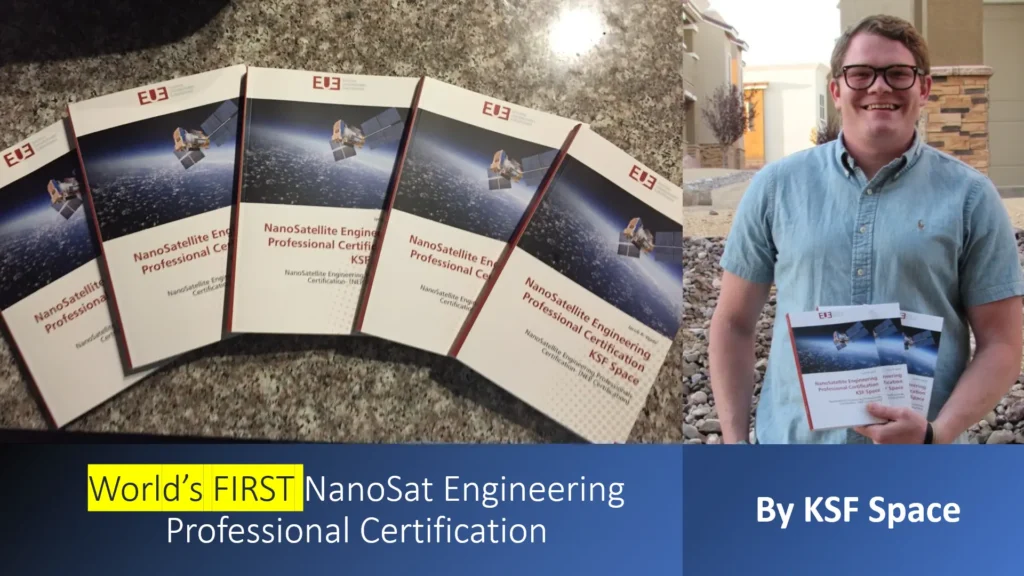
In the rapidly evolving landscape of NewSpace, professional validation has become the cornerstone of career success. As satellite constellations grow and orbital debris regulations tighten, the demand for certified experts is at an all-time high. The Small Satellite “SmallSat” Certification by KSF Space represents the global gold standard for individuals and organizations aiming to master the complexities of modern spacecraft engineering.
This comprehensive guide explores why the Small Satellite “SmallSat” Certification is the definitive credential for the next generation of aerospace leaders.
The Ultimate Guide to Small Satellite “SmallSat” Certification by KSF Space
The shift from massive, multi-billion-dollar satellites to agile, cost-effective small satellite constellations is no longer a future trend—it is the current reality of 2026. At the heart of this transformation is the Small Satellite “SmallSat” Certification, technically known as the Nanosatellite Engineering Professional (NEP) designation.
Developed by a global committee of aerospace veterans, this program bridges the critical gap between academic theory and orbital reality. Whether you are an aspiring engineer, a researcher, or a tech professional pivoting into the space sector, obtaining a Small Satellite “SmallSat” Certification ensures you possess the technical rigor required to design, build, and operate missions that survive the harsh environment of Low Earth Orbit (LEO).
Why Small Satellite “SmallSat” Certification is Essential in 2026
The “NewSpace” era has democratized access to the stars, but it has also raised the bar for mission success.Statistics show that a significant percentage of first-time SmallSat missions fail due to preventable engineering oversights. By pursuing the Small Satellite “SmallSat” Certification , professionals learn to mitigate these risks using industry-standard frameworks like NASA-GSFC-STD-7000 (GEVS).
1. Global Industry Recognition
Major space agencies and private giants like SpaceX and Blue Origin now recognize the NEP credential as proof of technical proficiency. Holding a Small Satellite “SmallSat” Certification from KSF Space signals to employers that you can handle complex payload integration, link budget calculations, and orbital mechanics without the steep learning curve typical of junior hires.
2. Addressing the Skills Gap
Traditional aerospace degrees often move slower than the technology they describe.The Small Satellite “SmallSat” Certification focuses specifically on Commercial-Off-The-Shelf (COTS) components, which are the backbone of the modern industry. This specialized focus ensures that your skills are “flight-ready” from day one.
Technical Curriculum: What You Master During Certification
The Small Satellite “SmallSat” Certification is divided into ten intensive chapters that cover the entire lifecycle of a mission. From the initial “Building a Mission” phase to “End-of-Life” operations, the curriculum is designed for maximum retention and practical application.
Mission Design and Orbital Mechanics
Every successful launch starts with a clear objective. The Small Satellite “SmallSat” Certification teaches you how to select the right orbit (LEO, MEO, or GEO) and calculate Keplerian elements. You will master the mathematics behind stable orbits and learn to coordinate with launch providers for rideshare opportunities.
Spacecraft Subsystems and Integration
A SmallSat is a complex “system of systems” packed into a very small volume. To earn your Small Satellite “SmallSat” Certification , you must demonstrate expertise in:
- EPS (Electrical Power System): Managing solar arrays, battery protection, and power distribution.
- ADCS (Attitude Determination and Control): Ensuring the satellite points accurately using magnetorquers or reaction wheels.
- OBDH (On-Board Data Handling): Understanding the “brain” of the satellite and real-time operating systems.
- Telecommunications: Calculating link budgets and managing frequency filing with the FCC.
Survival in the Harsh Vacuum of Space
The vacuum of space is unforgiving. Through the Small Satellite “SmallSat” Certification , candidates study:
- Thermal Management: Dissipating heat via radiation in a vacuum.12
- Radiation Shielding: Protecting on-board computers from high-energy particles.13
- Outgassing: Selecting materials to prevent lens fogging and sensor degradation.14
Hardware Synergy: Bridging Theory and Practice
While the core Small Satellite “SmallSat” Certification is a professional theoretical validation, KSF Space offers a unique path to hands-on experience. Participants can utilize the world-renowned CubeSat Kit Version 2.0 to apply their knowledge.
Aerospace-Grade Materials
The certification dives deep into material science, explaining why Aluminum 6061-T6 and 7075 are the gold standards for structural integrity. For missions where mass is critical, KSF Space also trains engineers on the use of advanced PA11 polymers, which offer a 40% mass reduction compared to traditional aluminum frames.
Testing and Flight Heritage
One of the most valuable aspects of the Small Satellite “SmallSat” Certification is the alignment with KSF Space‘s flight heritage. By learning from an organization that operates its own near-space testing and suborbital rocket platforms, students gain insights into the “Max-Q” phase of launch and environmental verification that few other programs can offer.
Career Impact: The Value of an NEP Credential
In a competitive job market, the Small Satellite “SmallSat” Certification serves as a powerful differentiator. It is not just a digital badge; it is a testament to your ability to handle high-stakes projects.
| Benefit | Description |
|---|---|
| Increased Salary | Certified professionals often see a significant increase in employment prospects and average wages. |
| Networking | Join an elite global network of over 1,700 Small Satellite (“SmallSat”) Certification holders. |
| Credibility | Demonstrates the ability to manage a mission from start to finish, including regulatory compliance. |
| Global Access | The program is online and self-paced, making it accessible to engineers worldwide. |
Frequently Asked Questions (FAQ)
Q: How long does it take to complete the Small Satellite “SmallSat” Certification?
A: The program is self-paced and hosted on a flexible 24/7 digital platform. Most candidates complete the requirements within 4 weeks to 3 months.
Q: Is the Small Satellite “SmallSat” Certification recognized by NASA or ESA?
A: The curriculum is developed by experts from major aerospace schools and industries.20 It follows NASA-GSFC-STD-7000 (GEVS) standards and is recognized as a benchmark for technical proficiency in the NewSpace sector.21+1
Q: Does KSF Space provide launch support after certification?
A: Yes. KSF Space assists universities and startups in finding ride-share opportunities and launch options for SmallSats that meet the rigorous design and testing standards taught in the course.
Q: Can I get a physical kit for hands-on training?
A: Absolutely. While the Small Satellite “SmallSat” Certification is a theoretical validation, KSF Space offers bundles that include the CubeSat Flight Model or the Version 2.0 Kit for practical assembly.
Contact Information
Ready to launch your career in the space industry? Reach out to the experts at KSF Space to learn more about enrollment, corporate training, or hardware kits.
Official Website: www.ksf.space
Support Email: info@ksf.space
Program Details: Small Satellite “SmallSat” Certification
By choosing to become a certified professional, you aren’t just buying a course; you are joining a global community dedicated to the democratization of space. With the Small Satellite “SmallSat” Certification , the barrier to the stars has never been lower.