
CEO at 4DBC Group
Small Satellite Course
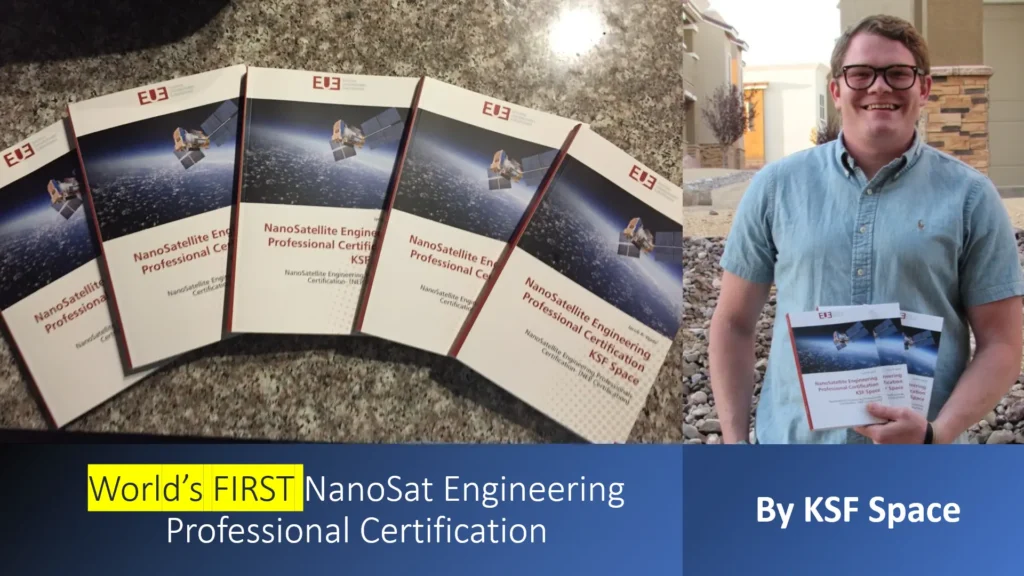
In the rapidly evolving landscape of the 21st-century “NewSpace” economy, the barrier to entry for the final frontier has been dismantled. No longer the exclusive domain of national agencies with billion-dollar budgets, space is now a marketplace of innovation driven by startups, universities, and private researchers. At the heart of this revolution is the need for specialized knowledge a gap filled by the Small Satellite Course “Small Sat” offered by KSF Space.
Whether you are an aspiring aerospace engineer, a researcher, or a tech professional looking to pivot, understanding small satellite technology is your gateway to the future of global connectivity, Earth observation, and interplanetary exploration.
Mastering the Orbit: The Ultimate Guide to the KSF Space Small Satellite Course “SmallSat”
The shift from massive, bus-sized satellites to CubeSats and SmallSats has created a massive skills gap. Industry leaders are looking for professionals who understand the lean, agile methodologies of small satellite development. This is where the Small Satellite Course “SmallSat” becomes a critical asset for your professional portfolio.
As we move further into 2026, the demand for certified “Nanosatellite Engineering Professionals” (NEP) has reached a critical peak. Unlike traditional academic programs that take years to complete, the Small Satellite Course “SmallSat” provided by KSF Space is designed for immediate industry relevance.
Why Enroll in a Small Satellite Course “SmallSat” Today?
The global satellite market is no longer exclusive to national space agencies. Today, “NewSpace” is driven by agility, rapid prototyping, and the 1U to 3U standard. Enrolling in a Small Satellite Course “SmallSat” is the most effective way to gain the technical experience required to navigate this landscape.
The Rise of Small Satellite Constellations
Traditional satellites take a decade to build. A Small Satellite Course “SmallSat” teaches you how to design systems that can be deployed in months. These constellations provide:
Global IoT Connectivity: Powering smart cities and remote industrial monitoring.
Real-time Climate Monitoring: Tracking deforestation and carbon emissions with high temporal resolution.
Rapid Response Disaster Management: Providing emergency communications during floods or earthquakes.
Career Opportunities in the NewSpace Era
By completing a Small Satellite Course “SmallSat” from KSF Space, you position yourself for roles such as Mission Architect, Systems Engineer, or Payload Integration Specialist. Industry data suggests that professionals holding vocational certifications in specialized aerospace fields can see significant increases in average wages and employment prospects.
Comprehensive Curriculum: What You Will Learn
The Small Satellite Course “SmallSat” specifically the Nanosatellite Engineering Professional (NEP) Certification—is structured into intensive chapters designed by industry experts from KSF Space to ensure that every participant gains “mission-ready” knowledge.
1. Mission Analysis and Orbital Mechanics
Understanding the physics of space is the first step. In the Small Satellite Course “SmallSat”, you will master:
Keplerian Elements: Defining stable orbits for your mission.
Perturbations: How atmospheric drag and solar radiation affect satellite longevity.
De-orbiting Strategies: Complying with international space debris regulations to ensure sustainable space use.
2. Spacecraft Subsystems and Architecture
The Small Satellite Course “SmallSat” breaks down the “bus” into manageable modules:
EPS (Electrical Power System): Managing solar arrays and battery discharge cycles.
OBDH (On-Board Data Handling): The “brain” of the satellite, often utilizing microcontrollers like the ESP32 for agile development.
ADCS (Attitude Determination and Control System): Ensuring your satellite points correctly using magnetorquers or reaction wheels.
Telecommunications: Mastering link budgets and RF frequencies, including advanced LoRA (Long Range) modules.
3. Assembly, Integration, and Testing (AIT)
Theory isn’t enough for orbital success. The Small Satellite Course “SmallSat” teaches you how to perform vibration tests, thermal vacuum cycles, and electromagnetic compatibility (EMC) checks. You will learn the NASA-GSFC-STD-7000 framework, ensuring your design survives the violent journey of a rocket launch.
The KSF Space Advantage: Bridging Theory and Reality
While the Small Satellite Course “SmallSat” provides world-class theoretical knowledge, KSF Space offers an optional, high-value upgrade for those seeking hands-on experience: the CubeSat Kit Version 2.0.
Hardware Synergy for Real-World Skills
Students can apply the concepts from their Small Satellite Course “SmallSat” by working with flight-proven materials. The kit includes:
Aerospace-Grade Aluminum (7075): For high-power missions requiring superior heat dissipation.
Advanced PA11 Polymer: A bio-sourced material that is 40% lighter than aluminum, perfect for mass-sensitive launches.
By choosing KSF Space, you are leveraging a design that has been refined through years of practical application. Their models have been used by global research institutions to validate sensors and train the next generation of aerospace engineers.
Frequently Asked Questions (FAQ)
What is the Small Satellite Course “Small Sat”?
It is a professional-grade certification program developed by KSF Space to provide engineers and students with the technical and regulatory skills needed to design, build, and operate nanosatellites (1U to 3U standard).
How long does it take to complete the course?
The Small Satellite Course “SmallSat” is completely self-paced. There is no fixed timeframe for completion; you move at the speed that suits your schedule, ensuring you master each concept through the online recorded video lectures and presentation Ebooks.
Who should take this certification?
The Small Satellite Course “SmallSat” is ideal for STEM students, aerospace engineers looking to pivot to NewSpace, and researchers planning their own orbital missions.
Does the course include hardware?
The standard Small Satellite Course “SmallSat” is a theoretical and technical validation. However, KSF Space offers bundles that include physical hardware kits, such as the CubeSat Kit v2.0, for hands-on assembly and prototyping.
Is the certification recognized globally?
Yes, the NEP (Nanosatellite Engineering Professional) credential earned via the Small Satellite Course “SmallSat” is recognized by major space agencies, foundations, and private aerospace firms like SpaceX and Rocket Lab.
Contact Information
Ready to take your career into orbit? Reach out to the experts at KSF Space for more information on enrollment, university partnerships, or purchasing hardware kits.
Website: www.ksf.space
Email: info@ksf.space
Course Details: Small Satellite Course “SmallSat” Certification