
CEO at 4DBC Group
Small Satellite Training
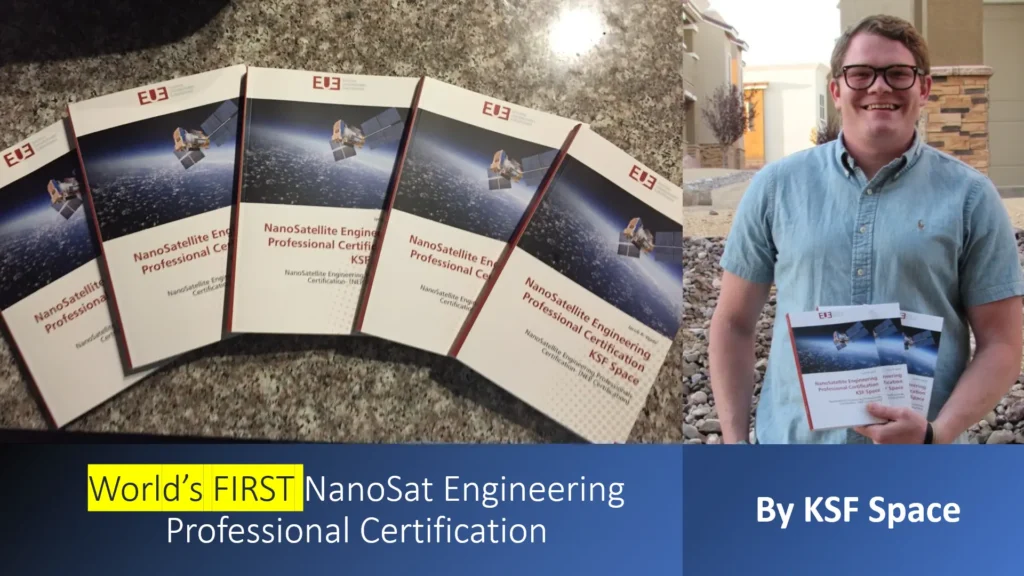
In the rapidly evolving landscape of the “NewSpace” era, the demand for specialized expertise has never been higher. As massive, bus-sized satellites give way to agile nanosatellites, professionals and students alike are seeking pathways to master this miniaturized frontier. KSF Space , a leader in democratizing space access, offers the premier Small Satellite Training “SmallSat” program designed to bridge the gap between academic theory and orbital reality.
This article explores how the Small Satellite Training “SmallSat” certification by KSF Space is reshaping the aerospace workforce through its Nanosatellite Engineering Professional (NEP) curriculum.
Small Satellite Training “SmallSat” by KSF Space: The Global Standard for Nanosatellite Engineering
The shift toward small satellite constellations has disrupted traditional aerospace timelines. Projects that once took a decade are now being deployed in months. To keep pace, the industry requires a new breed of engineer—one who understands lean engineering, COTS (Commercial-Off-The-Shelf) integration, and the rigorous standards of NASA and ESA. The Small Satellite Training “SmallSat” provided by KSF Space offers exactly this expertise.
Why Enroll in Small Satellite Training “SmallSat”?
TheSmall Satellite Training “SmallSat” is not just an educational course; it is a professional designation. Whether you are an aspiring aerospace engineer, a researcher, or a startup founder, this program provides the technical and regulatory foundation needed to lead a successful mission.
Key Benefits of the NEP Certification:
- Industry Recognition: The NEP credential is recognized globally by space agencies and private corporations.
- Comprehensive Lifecycle Coverage: Learn everything from Mission Analysis (Phase A) to Launch and Operations (Phase D).
- Flexibility: Designed for busy professionals, the program features online recorded lectures and a digital “Mission Handbook” ebook.
- Cost-Effective Innovation: Master the art of building high-performance systems on a fraction of the traditional budget.
Curriculum Overview: Mastering the SmallSat Mission Lifecycle
The Small Satellite Training “SmallSat” curriculum is meticulously structured into core modules that mirror the development of a real-world satellite. Participants dive deep into the subsystems that allow a 1U, 2U, or 3U CubeSat to survive and thrive in the harsh environment of Low Earth Orbit (LEO).
1. Mission Planning and Orbital Mechanics
Every successful mission begins with a clear objective. The Small Satellite Training “SmallSat” teaches you how to define mission requirements, select optimal orbits (such as Sun-Synchronous or LEO), and calculate link budgets to ensure reliable communication with ground stations.
2. Space Environment and Satellite Subsystems
Space is a hostile environment. This module covers:
- Thermal Management: Managing heat in a vacuum where convection is non-existent.
- Radiation Hardening: Protecting on-board computers (OBC) from high-energy particles.
- Power Systems (EPS): Optimizing solar cell efficiency and battery storage.
- ADCS: Maintaining precise attitude determination and control to keep your sensors pointed at the target.
3. Assembly, Integration, and Testing (AIT)
Before a satellite is integrated into a deployer like the P-POD, it must undergo rigorous testing. The Small Satellite Training “SmallSat” provides the theoretical framework for vibration testing (surviving launch G-forces) and thermal vacuum cycling.
From Theory to Hardware: The CubeSat Kit 2.0
While the Small Satellite Training “SmallSat” is a world-class theoretical certification, KSF Space recognizes that true mastery comes from physical application. To support this, they offer the CubeSat Kit Version 2.0, which aligns perfectly with the training modules.
| Feature | Specification |
|---|---|
| Material | Aerospace-grade Aluminum or PA11 Polymer |
| Connectivity | Triple LoRa Support (433 / 868 / 915 MHz) |
| Processing | ESP32-based MCU with specialized sensor boards |
| Standards | Fully compliant with NASA / ESA CubeSat Design Specifications |
The kit allows students of the Small Satellite Training “SmallSat” to practice hands-on assembly, testing the very systems they studied in the lectures.
Frequently Asked Questions (FAQ)
What is the “SmallSat” Training program?
The Small Satellite Training “SmallSat” is a professional certification program by KSF Space that covers the design, engineering, and launch of nanosatellites.
Who is eligible for the NEP Certification?
The program is open to university students, aerospace engineers, researchers, and professionals looking to pivot into the NewSpace industry.
Is the training hands-on or theoretical?
The core Small Satellite Training “SmallSat” is a comprehensive theoretical certification. However, participants can purchase the CubeSat Kit 2.0 from KSF Space for hands-on labs.
How long does it take to complete?
Most students complete the Small Satellite Training “SmallSat” modules and pass the final exam within 2 to 4 months.
Does KSF Space assist with launches?
Yes, KSF Space provides guidance on finding launch opportunities and ensuring compliance with international space law and debris mitigation policies.
Get Started with KSF Space Today
Ready to launch your career into orbit? Join the global community of certified space professionals.
Website: www.ksf.space
Course Enrollment: Nanosatellite Engineering Professional Certification
Inquiries: info@ksf.space