
CEO at 4DBC Group
Small Satellite "SmallSat" Professional Course Certificate
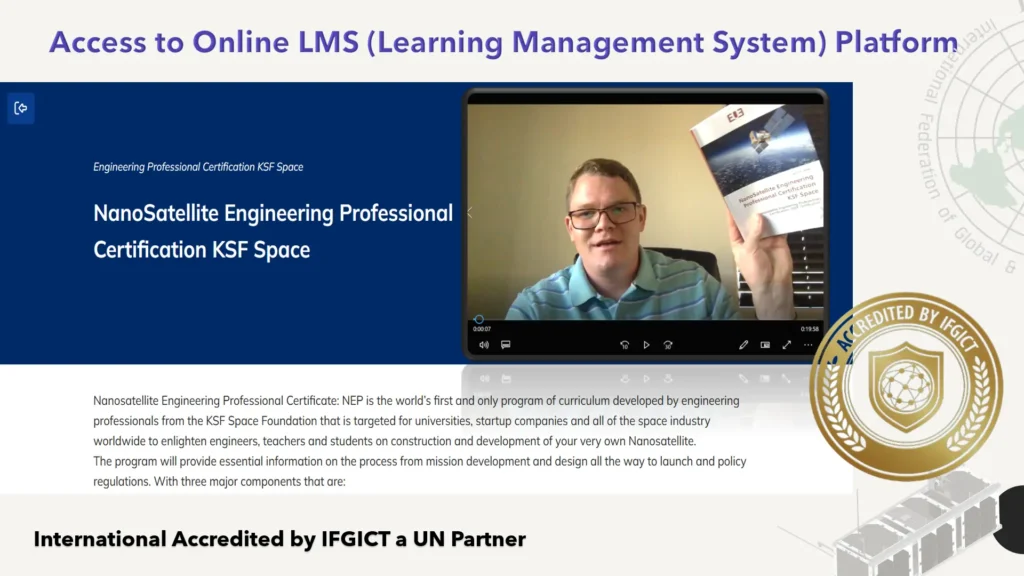
In the competitive landscape of the 2026 NewSpace economy, a general engineering degree is often just the beginning. To truly stand out and lead in the design of next-generation orbital constellations, specialized validation is required. The Small Satellite “SmallSat” Professional Course Certificate by KSF Space has emerged as the global gold standard for individuals and organizations aiming to master the complexities of modern spacecraft engineering.
This comprehensive guide explores how the Small Satellite “SmallSat” Professional Course Certificate bridges the gap between theoretical physics and flight-ready reality, providing the definitive credential for the next decade of space exploration.
The Definitive Guide to the Small Satellite “SmallSat” Professional Course Certificate by KSF Space
The aerospace industry is undergoing its most significant transformation since the Apollo era. The shift from massive, bus-sized satellites to agile, cost-effective small satellite constellations has democratized access to the stars.1 At the heart of this revolution is the Small Satellite “SmallSat” Professional Course Certificate, technically known as the Nanosatellite Engineering Professional (NEP) designation.
Developed by a global technical committee featuring veterans with heritage from NASA, ESA, and JAXA, this program is designed to equip engineers, researchers, and students with the technical rigor necessary for mission success.2 Whether you are an aspiring aerospace leader or a tech professional pivoting into the space sector, obtaining a Small Satellite “SmallSat” Professional Course Certificate from KSF Space ensures your skills are aligned with modern orbital standards.
Why Pursue a Small Satellite “SmallSat” Professional Course Certificate?
In 2026, mission reliability is the ultimate currency. Statistics show that a significant portion of first-time SmallSat missions fail due to preventable engineering oversights. The Small Satellite “SmallSat” Professional Course Certificate curriculum is meticulously structured to mitigate these risks by teaching the NASA-GSFC-STD-7000 (GEVS) standards.
1. Global Recognition and Credibility
Major space agencies and private giants like SpaceX and Blue Origin recognize the NEP credential as proof of technical proficiency.3 Holding a Small Satellite “SmallSat” Professional Course Certificate signals to recruiters that you can handle complex projects—including payload integration, link budget calculations, and orbital mechanics—without the steep learning curve typical of junior hires.
2. Flexible, Online Learning for a Global Workforce
Recognizing that the next great space innovator could be anywhere, KSF Space has structured the Small Satellite “SmallSat” Professional Course Certificate as a self-paced, online experience. The curriculum includes:
- High-Quality Video Lectures: Expert-led sessions covering everything from thermal management to de-orbiting strategies.4
- Comprehensive E-Books: Detailed technical references that serve as a permanent “flight manual” for your engineering library.5
- Rigorous Assessment: A final exam that ensures only those with a deep, practical understanding of the material earn the certificate.6
Technical Curriculum: From Mission Concept to De-Orbit
The Small Satellite “SmallSat” Professional Course Certificate program is divided into ten intensive chapters that cover the entire satellite lifecycle. This multi-modal learning experience ensures that every candidate masters the technical, regulatory, and operational aspects of a mission.7
Master the “Skeleton” and “Nervous System” of Spacecraft
A SmallSat is a highly integrated “system of systems.”8 To earn your Small Satellite “SmallSat” Professional Course Certificate, you must demonstrate expertise in:
- Electrical Power Systems (EPS): Managing solar energy harvesting, lithium-ion battery protection, and power distribution.9
- Attitude Determination and Control (ADCS): Ensuring the satellite points accurately using magnetorquers, star trackers, or reaction wheels.10
- On-Board Data Handling (OBDH): Understanding the real-time operating systems (RTOS) that serve as the satellite’s brain.11
Survival in the Harsh Vacuum of Space
The vacuum of space is an unforgiving environment. Through the Small Satellite “SmallSat” Professional Course Certificate, candidates study:
- Thermal Management: How to dissipate heat via radiation when convection is impossible.12
- Radiation Shielding: Protecting on-board computers (OBC) from high-energy particles and Single Event Upsets (SEUs).13
- Outgassing Mitigation: Selecting materials that won’t fog lenses or degrade sensors in a vacuum.14
Hardware Synergy: Bridging Theory and Practical Excellence
One of the unique advantages of KSF Space is the bridge between cognitive validation and physical hardware. While the Small Satellite “SmallSat” Professional Course Certificate is a knowledge-based program, it is built upon the same principles used in KSF Space’s flight-ready CubeSat kits.
Advanced Structural Materials
During the Small Satellite “SmallSat” Professional Course Certificate track, students learn about advanced materials:
- Aerospace-Grade Aluminum (7075): The industry standard for high-strength structural integrity and thermal conductivity.15
- Advanced PA11 Polymer: A revolutionary additive-manufactured material that is 40% lighter than aluminum, perfect for mass-constrained missions.16
Testing and Flight Heritage
One of the most valuable aspects of the Small Satellite “SmallSat” Professional Course Certificate is the alignment with KSF Space’s flight heritage. By learning from an organization that operates its own near-space testing platforms and suborbital rockets, students gain insights into the “Max-Q” phase of launch and environmental verification that few other programs can offer.17
Career Impact: The ROI of Professional Validation
In a competitive market, the Small Satellite “SmallSat” Professional Course Certificate serves as a powerful differentiator. It is not just a digital badge; it is a testament to your ability to manage high-stakes orbital projects.
| Benefit | Description |
|---|---|
| Industry Credibility | Recognized by major space agencies and private aerospace firms globally. |
| Global Network | Join a community of over 1,700 certified NEP professionals worldwide. |
| Skills Validation | Proven ability to design satellites according to NASA GEVS standards. |
| Career Advancement | Positions you for roles like Mission Architect, Systems Engineer, or Payload Integration Lead. |
Frequently Asked Questions (FAQ)
Q: What exactly is the Small Satellite “SmallSat” Professional Course Certificate?
A: It is a professional-grade credential issued by KSF Space after the successful completion of the NEP curriculum and exam. It validates your ability to design and engineer small satellites according to international standards.18
Q: How long does it take to complete the program?
A: The program is self-paced. Most participants complete the Small Satellite “SmallSat” Professional Course Certificate within 3 to 6 months, depending on their existing technical background.
Q: Is the certificate recognized by major agencies?
A: Yes. The NEP curriculum is aligned with NASA and ESA engineering standards and is highly respected as a benchmark for technical competence in the NewSpace sector.19
Q: Does KSF Space provide launch support?
A: Beyond the Small Satellite “SmallSat” Professional Course Certificate, KSF Space assists universities and startups in finding launch opportunities and navigating frequency licensing regulations.
Contact KSF Space
Ready to launch your career into orbit? Reach out to the experts at KSF Space to learn more about enrollment, institutional partnerships, or corporate training.
Official Website: www.ksf.space
Support Email: info@ksf.space
Certification Details: Small Satellite “SmallSat” Professional Course Certificate
By earning your Small Satellite “SmallSat” Professional Course Certificate, you are joining an elite global community of over 1,700 professionals who are actively building the future of orbital technology. Don’t just watch the next giant leap—lead it with KSF Space.