
CEO at 4DBC Group
Smart City LA 2028
In the rapidly evolving landscape of urban development, the concept of a “smart city” has shifted from a futuristic dream to a mandatory blueprint for global metropolises. As Los Angeles prepares for the world stage, the smart city la 2028 initiative stands as a beacon of how technology, sustainability, and international standards converge to redefine modern living.
At the heart of this transformation is the IFGICT (International Federation of Global & Green Information Communication Technology), a leading global authority that is bridging the gap between ambitious urban visions and standardized, measurable reality.
The Vision of Smart City LA 2028: A Blueprint for the Future
The smart city la 2028 strategy is more than just a preparation for upcoming global events; it is a comprehensive roadmap to enhance the quality of life for every Angeleno. By integrating Internet of Things (IoT) sensors, 5G connectivity, and data-driven governance, Los Angeles is positioning itself as a premier intelligent ecosystem. However, building a smart city requires more than just installing hardware. It necessitates a unified framework that ensures interoperability, security, and long-term sustainability. This is where the IFGICT plays a pivotal role. By aligning urban strategies with global benchmarks, the federation ensures that projects under the smart city la 2028 umbrella are not just “high-tech” but truly “smart” according to international best practices.Why Standards Matter for Smart City LA 2028
Without common standards, a city risks creating “silos” of technology that cannot communicate with one another. To avoid this, IFGICT advocates for the adoption of:- ITU (International Telecommunication Union) Standards: Specifically those focusing on Key Performance Indicators (KPIs) for smart sustainable cities.
- IEEE (Institute of Electrical and Electronics Engineers) Standards: Ensuring the technical backbone of the city—from power grids to communication networks—is robust and scalable.
IFGICT Smart City Standard Certification: The Global Gold Standard
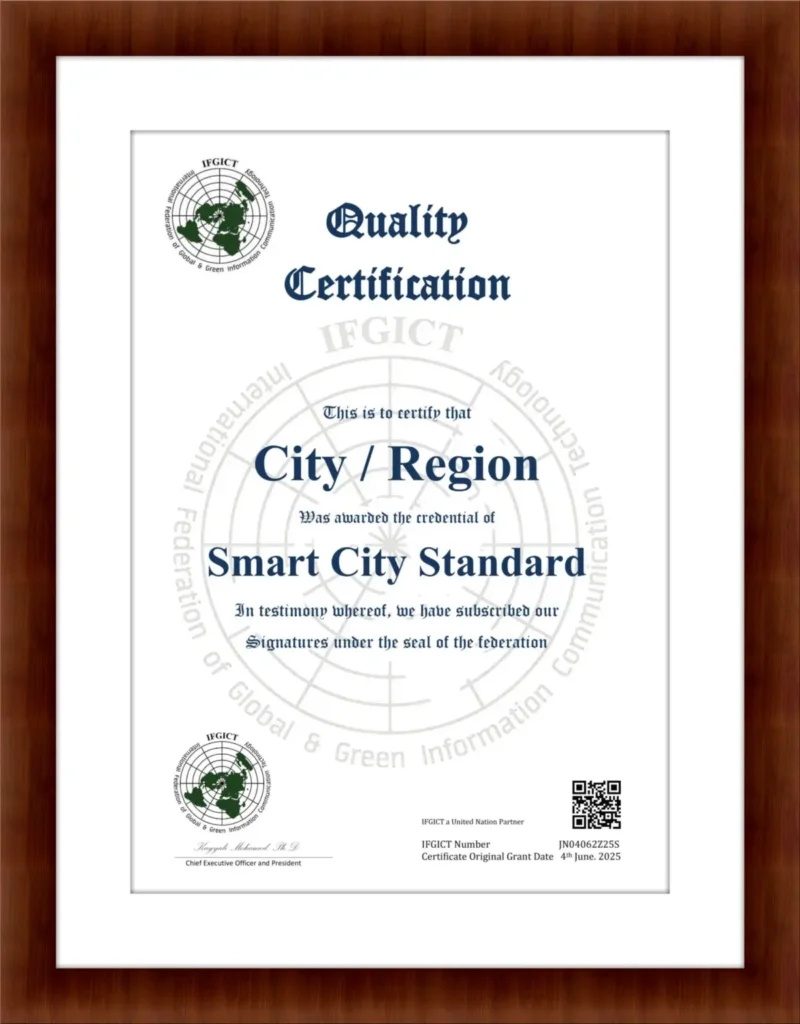
How does a municipality prove it has reached the pinnacle of urban intelligence? Through the IFGICT Smart City Standard Certification. This prestigious award is not just a trophy; it is a validation of a city’s commitment to its citizens and the environment.Online Review and Remote Auditing: Innovation in Certification
In an era where efficiency is paramount, IFGICT has revolutionized the certification process. Recognizing that cities worldwide need accessible validation, IFGICT now conducts online reviews and remote audits. Whether it is a burgeoning municipality in Southeast Asia or the massive infrastructure of smart city la 2028, the audit process can be initiated and managed entirely online. This remote capability allows for:- Global Accessibility: Any region or municipality, regardless of geographic location, can apply.
- Cost-Effectiveness: Reducing the need for extensive travel and on-site logistics.
- Real-Time Data Verification: Leveraging digital platforms to review a city’s KPIs and technological implementation.
Empowering Professionals: The IFGICT SCP and Auditor Pathway
A smart city is only as intelligent as the people who manage it. To support the smart city la 2028 goals, IFGICT offers the Smart City Professional (SCP) certification. This program is designed for urban planners, IT experts, and government officials who want to lead the charge in digital transformation.Becoming an SCP Auditor
The path doesn’t stop at professional certification. IFGICT provides a specialized track for those looking to become an SCP Auditor. These individuals are trained to conduct the very audits that award cities their “Smart” status. By becoming an SCP Auditor through IFGICT, professionals gain:- Deep knowledge of ITU & IEEE smart city frameworks.
- Expertise in Green ICT and sustainable urban development.
- The authority to evaluate and guide municipalities toward international certification.
Key Components of a Certified Smart City
When IFGICT evaluates a region for the smart city la 2028 standard, several key dimensions are analyzed:| Dimension | Focus Area | Standard Basis |
|---|---|---|
| Smart Governance | Transparency, E-Government, Citizen Participation | ITU-T |
| Smart Mobility | Intelligent Transport, EV Infrastructure, Traffic Management | IEEE 2413 |
| Smart Environment | Green Energy, Waste Management, Carbon Tracking | ISO / IFGICT |
| Smart Infrastructure | 5G, IoT Security, Data Privacy | IEEE / ITU |